By 1755 even Sir Joshua Gregg RA himself was surprised by how far his fame (or notoriety if you prefer) had spread. He was in Paris on one of his many European tours when the letter arrived from what we now call Georgia requesting him to paint certain notables in the court of Count Gruzinsky on the eastern coast of the Black Sea. Ever seeking adventures and new challenges our artistic hero jumped at the chance, and the large fee being offered by this senior official of the Russian Royal Court.
The Count referred in particular to his 20 year old daughter, Natasha, the Countess Gruzinskaya (his wife having unfortunately died 3 years earlier) and his desire to have a tasteful portrait with which to attract an eligible suitor in Saint Petersburg, as she was long past marriageable age in aristocratic circles.
With that in mind Sir Joshua added to his portfolio a sketch given to him by his friend Francois Boucher a few years earlier. This was a pose Joshua had long admired (as he did all Monsieur Boucher's many paintings of ladies). It was a beautiful drawing sketched from life of a young girl on the fringes of the French Royal Court called Marie-Louise O'Murphy and whom Boucher had been commissioned to paint in 1752 for no less than King Louis himself. Josh also chuckled as he found the sketch he had done of Francois working on the painting. Maybe this trip would offer a chance to use it as inspiration.......
 |
Life sketch of Miss O'Murphy
|
 |
Boucher at work 1752. Pen and ink sketch by Sir Joshua Gregg
(tongue in cheek - actual artist unknown) |
So that Summer he found himself getting acquainted with the charming, intelligent and humorous Natasha. She was unlike Boucher's well endowed young teenage blonde of the French Court but was dark, slightly Asiatic in appearance, mature for her years and with a beautifully proportioned figure. Like all aspiring Russian noblewomen she was keen to improve her knowledge of France and French language and Sir Joshua was very happy to give her his insights during the posing sessions. He gained her confidence to such an extent that, soon after the official portrait was completed, he had little difficulty in persuading her to give Boucher's pose a go. The Black Sea coastal Summer weather added to her enthusiasm to disrobe for an artist. The Georgian palace was well equipped with French style furniture, plump cushions and silk drapes and Natasha joined in keenly with arranging them.....
 |
Lady at rest - Countess Natasha Gruzinskaya, 1755. Oil on board, 22 inches x 16 inches
by Sir Joshua Gregg RA |
.............choosing a long blue hair ribbon and plucking some roses from the garden to scatter in some semblance of how Sir Joshua described Boucher's original touching scene........
He also told her there needed to be a book in the foreground and so she found the well-thumbed first edition of Moliere's "L'ecole Des Femmes" which her father had insisted she read as he seemed to think (despite being written 100 years earlier) that it contained useful advice for a young wife in sophisticated society.
However, anyone familiar with their classic French literature will view the pensive look on Natasha's face and wonder....She was not to be the ugly and stupid, but honest, bride desired by Arnolphe in the play; she was already a headstrong, free spirited, highly intelligent and capable young woman. She was her father's daughter....an expert horsewoman and already a match with the sabre for any officer in her father's regiment - the Gruzinsky Hussars. This time with Sir Joshua at least gave her an opportunity to show her softer side and indulge in some intellectual conversation away from the rough horseplay of the officer's mess...............
XXXXXXXXXXXXXXXXXXXXXXX
Well thank you, dear reader, for indulging me thus far!
Many followers of this blog will, like me, be admirers of the style as well as the military history and costume of the 18th century and Francois Boucher embodies that decadence in much of his work. When I first met Yaroslavna in 2014 and discussed with her the kind of posing she wanted to do, apart from Hussarettes and the other fantasy subjects, we thought something tasteful by Boucher would be good.
I'm indebted to that noted wargamer-blogger and art connoisseur
Legatus Hedlius for his research on this painting of Marie Louise O'Murphy and can do no better than quote some extensive pieces from his blog. Please enjoy the different renditions of the original painting under various titles, and his information.
 |
| Ruhendes Madchen |
"Mary-Louise O'Murphy de Boisfaily by François Boucher (1703-1770). She was the fifth daughter of an army officer of Irish extraction, Daniel O'Murphy de Boisfaily. She was born in Rouen on October 21st 1737. After her father died her mother took her to Paris where the widow traded in second hand clothes whilst finding work for her daughters. Mary-Louise became a dancer at L'Opera and a model. Casanova knew her (she is mentioned in his diaries) and she may have been his mistress, briefly. Casanova certainly introduced her to Boucher who painted this picture of her in 1752 and also had an affair with her (33 year age difference not withstanding). It has been argued that the picture was produced as a direct invitation to Louis XV; demonstrating that she was available to be his mistress |
| Louise O'Murphy |
 |
| Marie-Louise O'Murphy |
She quickly became one of Louis' second tier mistresses and stayed so for two years. Louis had an official mistress, of course, Madame de Pompadour. Mary-Louise bore the king an illegitimate daughter, Agathe Louise de Saint-Antoine (1754-1774), but she tried to oust Madame de Pompadour from top mistress spot and was soon kicked out of the court and married off to Comte de Beaufranchet, who must have been very cheered by this development, as Mary-Louise was still only 17. He didn't get to enjoy her for very long, though, as he was killed at the Battle of Rossbach in 1757, where Frederick the Great smashed a combined Franco-Austrian army. Mary-Louise subsequently had two more husbands, including one who was thirty years younger than her who she married at the age of 61! Although she was imprisoned for a time during the French Revolution she survived The Terror and died in 1814 at the age of 77. The painting now hangs in the Alte Pinakothek in Munich. It is a comparatively small picture: about 24" by 29" and was just the sort of sized picture Boucher would turn out for the cabinets of his wealthy gentleman collectors.
 |
| Resting Girl |
Boucher also painted another version of the painting, which is in the Wallraf-Richartz-Museum in Cologne, but it doesn't quite have the plump pliancy of the original. Boucher was a prolific artist, producing over 10,000 drawings during his life, and at the time was criticised for churning out paintings for the money."
 |
| The blonde odalisque |
I certainly did not "churn this out for the money" and I hope its new owner will think the painting good value for a modest outlay. Like Legatus I just admired the simplicity and supposed innocence of the subject and it was a bit of surprise later to find out about her questionable life! I did not know that when Yara and I set out on this mini-adventure. My Russian model proved to be enthusiastic and most supportive, setting up the scene with drapes, sheets and cushions. Here we are making adjustments to try to fit the photos of the original painting.
As more than one version of Marie-Louise O'Murphy was painted I did not feel obliged to be totally authentic and the colours of Yara's furnishings sets off her skin so well I absolutely loved the effect. I hope you do too.
I used the full blown classic techniques of outline sketch, grisaille underpainting then colour underpainting and finally many layers of oil colour to get the richness this subject needs. I had cut the canvas board to fit a lovely 18th Century style frame I had already. It was gilt and a bit garish for modern tastes so I repainted it in thinned acrylic and then dry-brushed all the raised Rococo style detail in gold acrylic paint. I think the result is smart, elegant and slightly "edgy", and sympathetic to the painting without overpowering; which is what a frame should be. This painting of Natasha needs to dry thoroughly and then have several coats of gloss varnish. When finished it will have the feel of a 250 year old oil painting - but look fresh of course!

As if I was not already lucky enough to have done the photoshoot and then the painting, the first client I showed some photos of it to snapped it up! That is Colin Ashton, an avid collector and so far has about a dozen of my paintings. So it will be wending its way "up north" in June. Many readers will know Colin in person or through his wonderful and prolific blogging
Carryings on up the Dale .
And for the wargamers - some reminders of Natasha's other exploits.
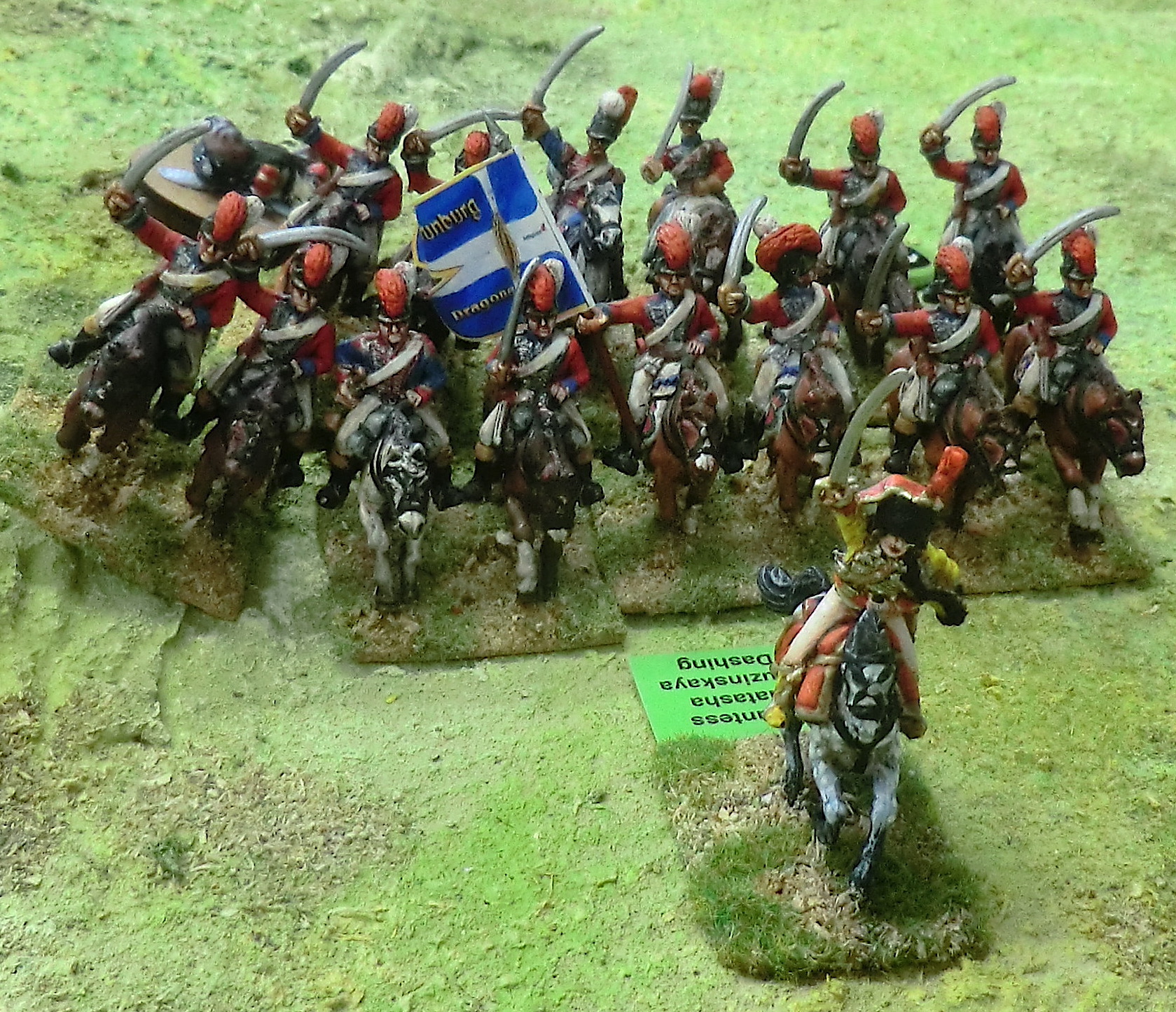
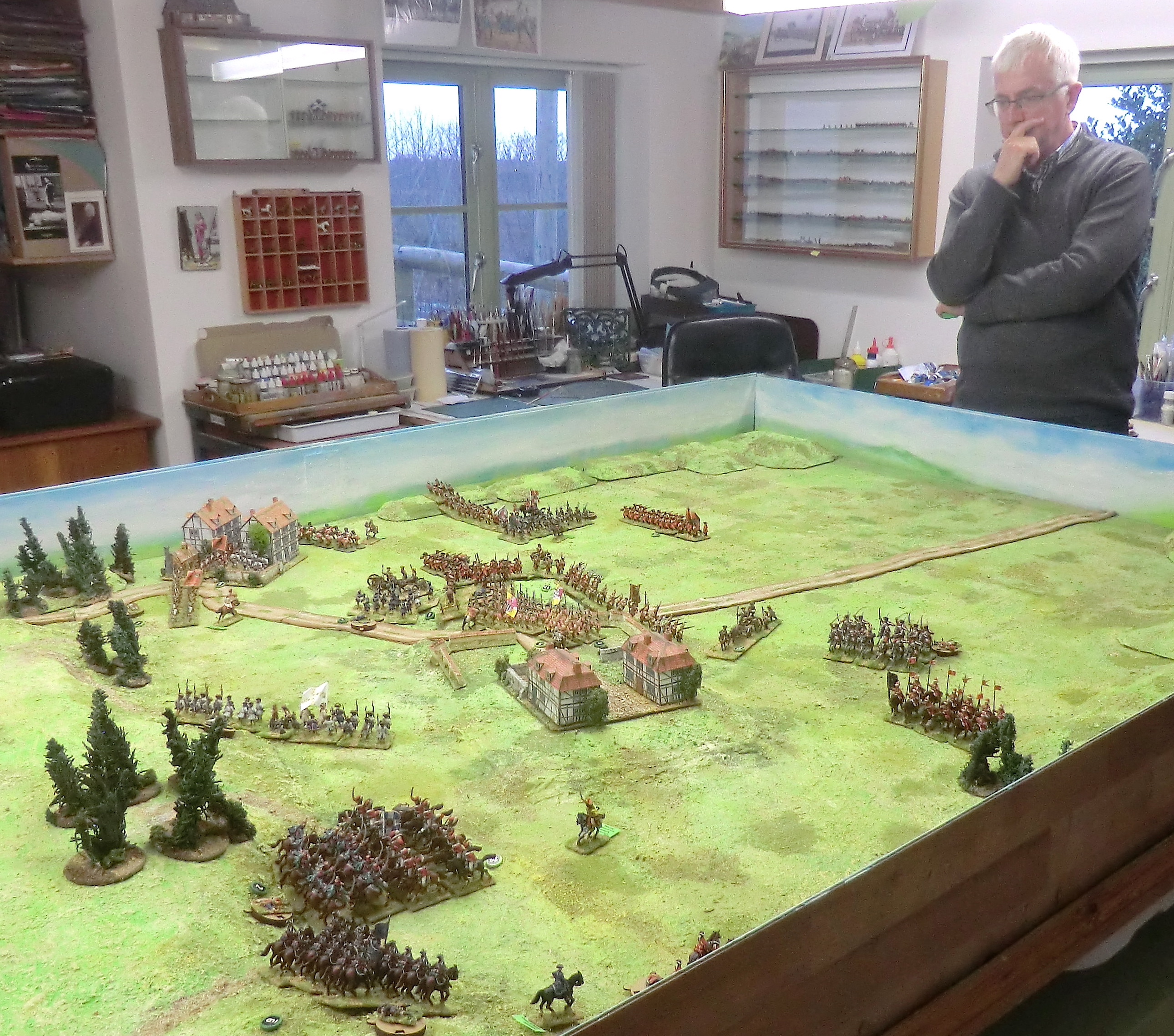
She got the chance to show off in the Battle of Pepperoni on 22nd June 1760. This was a game which took place in January 2018 and I never blogged about it for some reason. Count Gregorius had been charged by the Empress to lead an expeditionary force of the Grunburg Contingent to attack Savoy from the southern borderlands with Italy. He caught a French and Savoy force defending high ground near the village of Pepperoni. I will spare you a full report (it's a long time ago for my memory!) but I've tried to concentrate on Major-General Countess Natasha Gruzinskaya and her cavalry brigade:
And you can generally spot Natasha as she is the Hussar commander with the yellow pelisse and the um....er...flesh coloured breeches!
 |
| Grunburg Household Cavalry Brigade |
 |
| Grunburg Hussars take on the French Royal Dragoons while the Orleans dragoons are taken by surprise in the rear by Black Hussars |
 |
| Major General Natasha brings up the Heavy Grunburg Dragoons |
 |
| But her brigade is split up by the ebb and flow of cavalry action |
 |
| Causing Count Gregorius (on this day played by South London Warlord extraordinaire Martin Gane) to think really hard. |
 |
| The Grunburg Dragoons have seen off the other French cavalry and turn on the Orleans Dragoons who are now trapped by the Grunburg Uhlanen and some allied Freicorps infantry |
 |
| The Freicorps move off but the French Dragoons are trying to fight their way out |
 |
| After a further round of melee Major General Natasha claims the entire Orleans regiment as prisoners in her first battle for Gregorius. Next time a Division or Wing commander? |
As usual with these specialist images, if you post elsewhere you must give me credit as the artist and owner of the copyright, and link back to this blog, thank you.
And if that is not enough please see loads more of my art as well as Military and Hussarette subjects on my new Art website Chris Gregg Art