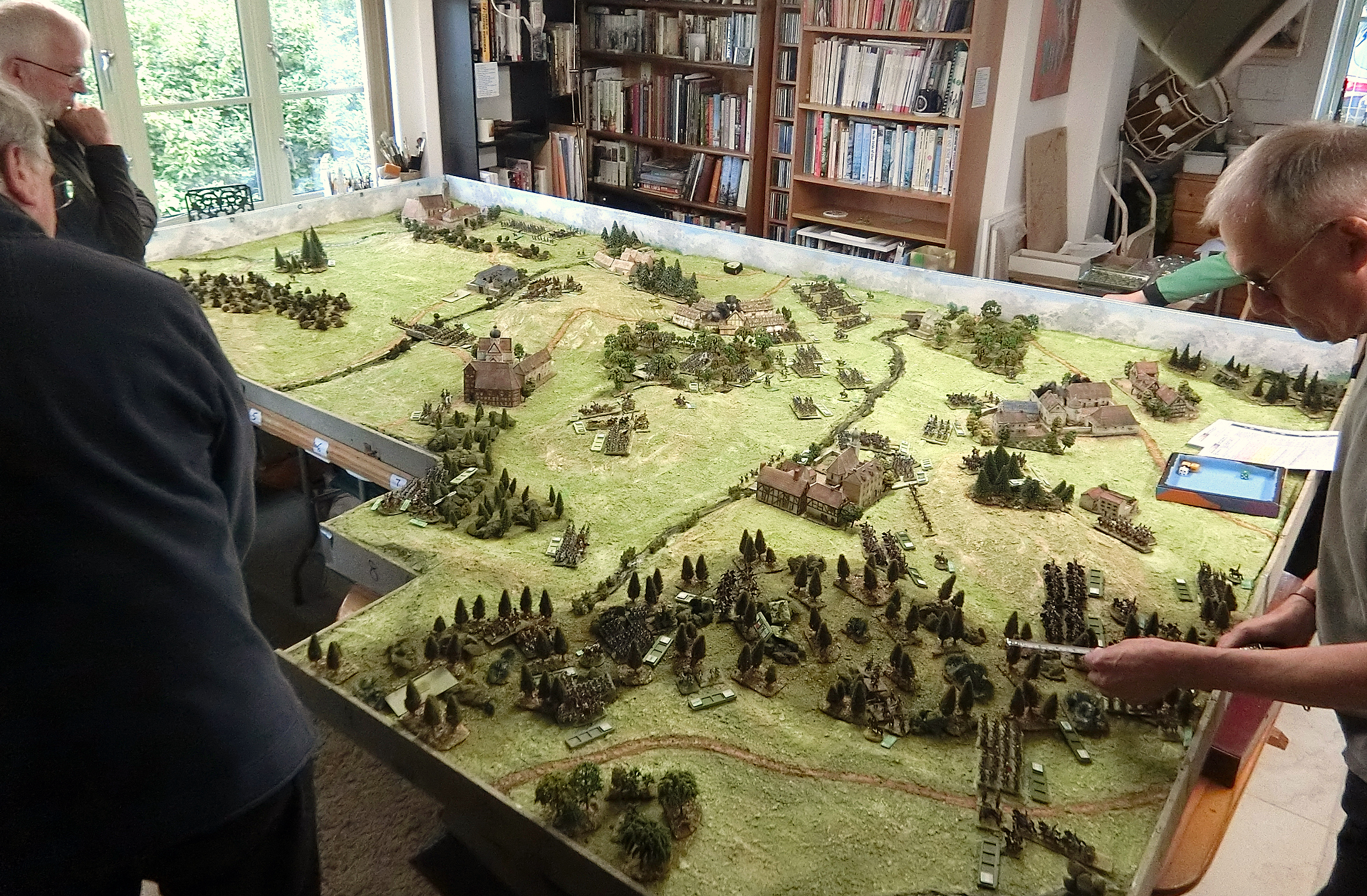
For those just arriving you can see the background in Part One and here is a link to Part Two which describes the first day's play and the first 2.5 hours of historical action. Sincere apologies for the long delay in bringing you this; just too many distractions and responsibilities compounded by a fairly serious computer issue!
Quick Catchup
Hiller commands the strung-out Left Wing of the Austrian Army. He doesn't really know what to do but suggests Archduke Louis holds firm and offers to support him and the isolated Thierry if they are attacked. As a reminder the strategic map available to the Allies is shown below (hence Austrian positions are hazy). The first two Bavarian Divisions and Hugel's Light brigade attacked about 1030 on a broad front and found the Austrians fairly tough in places, and falling back in others. About midday the Light Cavalry of Lannes provisional corps hit Thierry's outer positions from the North. When we left off, about 1pm game time, battle was beginning to be joined south of Bachl. Hiller was slowly moving reinforcements towards Sellingberg and Louis was holding the area between that town and Perka, except Bavarians had just broken through around The Horlbachs. Louis' line was being overlapped in the South by some of Hugel's Wurttemburg light troops near Siegenburg....there was still everything to play for and more troops to join in.

Players and "substitutes"
As always I must pay tribute to those friends near and far, who make the effort to come to this out-of-the-way corner of the Cotswolds. The only Saturday players who could stay on till Sunday were Paul B and Martin Gane as the two main Austrian Corps commanders. They were joined by Steve Johnston from Bristol who took the thankless role of Thierry on the promise of more troops if he lost his too quickly! There was a complete change on the Allied side (well almost, if you exclude me). Stuart C of Cirencester took on the mantle of Lefebvre with the three Bavarian Divisions - a big job . Glenn Lowcock took charge of Lannes' flank attack which had only just started when we left on the Saturday and there was considerably more to come. Apart from Hugel's Light brigade the rest of the Wurttemburg Corps was very nearly available. They were receiving the same pep talk from Napoleon as the Bavarians had had ,but it would take a bit of time for the word to spread. However, it meant all the Wurttemburg units went up one Morale grade. Nominally I was still Napoleon again, trying to ensure all the off-field Allied reinforcements were organised as well as officiating on-table if called on (everyone was great though and did not need me much). In practice I "stepped back" as Napoleon in order not to unduly influence the tabletop events. We had the luxury of a "spare" Marshal Bessieres on the staff and I was able to use him to coordinate all the unused troops to surge towards the Austrian left flank at Siegenburg to aim for Tolbach. That meant pulling off Deroy's Bavarian 3rd Division to combine with the Wurttemburg Infantry and cavalry to head South as fast as possible (using our off table faster movement).
For the Austrians' part things stayed much the same as before, except the loss of Sallingberg, the Horlbachs and presence of enemy overrunning Siegenburg, triggered a message from Hiller to call up the Reserve Corps from near Pfeffenhausen. They were to make as fast speed as possible to arrive around table square 1F.
So the scene was set for another intense day.
 |
Newcomers - Stuart begins the Bavarian follow through up the Sellinberg valley. Glenn and Steve commence the day-long struggle progressing Lannes' movements from where the table joins the "extra bit". |
 |
| Old Hands - Paul B, being really a young lad and well into the tech world, confers with Martin over his plans stored in his phone |
 |
| Glenn uses the excellent quality of his Marshal, and some of the French generals, to boost the movement of his flanking brigades. Following the Light Cavalry of his vanguard there are 3 decent sized infantry regiments and two regiments of Cuirassiers, as well as artillery batteries. |
 |
| They have taken Bachl and moving fast across the stream. At right the retreating remnants of the infantry regiment which was garrisoning Bachl are hit by French Chasseurs à Cheval while "crossing" the game table transition line........ |
 |
| ..............the other half can be seen at bottom right. On the hill another regiment of Chasseurs has charged what remains of Thierry's flank. A few companies of Austrian skirmishers are bravely trying to slow them up to make time for their artillery to react. |
 |
Bavarians of Prince Ludwig's Division are dominating the hill and on down to Sellingberg
|
 |
| To the West Stuart is organising Wrede's Bavarian Division for a major thrust on Kirchdorf through the Horlbach woods |
 |
| By Horlbach village many of the Bavarian guns have coalesced into a "grand battery" (around 30 guns worth it looks like) to try to get rid of the menace of the second Austrian Heavy battery on the high hill |
 |
| Readers will recall one battery has now gone, but the Grenzer light battery and the Corps ammunition train are sheltering over the crest. In the distance the large Uhlan regiment of Radetsky's brigade waits anxiously with horse artillery near the only bridge across Perkabach...... |
 |
| ......and this is why - Wurttemburg General Hugel is storming across the open area with the Herzog Heinrich Chevauleger and the Light infantry to try to thwart any Austrian retreat towards Tolbach |
 |
| An overview of the central area: In the far woods Wurttemburg Jagers act as the vanguard for Stuart's Bavarians. Austrian sappers are just about to exit the Horlbachs satisfied that the small fire they have created will block off that route of access for a while even though the wind has dropped and it's not spreading far. Austrian Heavy guns on the hilltop and lots of light troops are still in possession of the fortified Perka village and the nearby dense woods. |
 |
| The purpose of this photo is to show that what remained of Thierry's command has now been destroyed or seen off. Bavarian Light Infantry are in the thick fir woods. Victorious French Chasseurs are just recovering after overcoming the artillery battery and capturing the retreating 29th Infantry regiment from Bachl. Austrians of Hiller's Corps can vaguely be seen in the distance getting ready to put up resistance across the road to Rohr if they can reach it before Lannes' Light infantry. |
 |
| While the Wurttemburgers were receiving their boost from Napoleon in person. Bessieres had been carrying out his orders and has now got part of Deroy's Bavarian Division to deploy just North of Siegenburg. So the Allies are fully stretching their opponents by taking the battle further South; will Martin be able to match them with Archduke Louis's Divisions? |
 |
| Shrewd tactician Martin Gane has held on as long as possible but Louis' heavy guns are now battered badly and forced to retreat. His light troops still block the valley below though. So now the decision has been made to despatch those Uhlans and cavalry battery across the Perkabach to try to match Hugel. |
 |
| Back on the extreme Allied left flank Glenn is storming ahead with Lannes' Provisional Corps . The Chasseur regiments of Jacquinot have united into a brigade formation, and behind them is St Sulpice's Cuirassiers brigade. The infantry regiments of Morand's Division have just arrived across the table "transition" |
 |
The view from above shows Austrian Chevau-Leger forming up to contest the woods
alongside line infantry shutzen companies in skirmish order |
 |
| By now Reuss-Plauen's three infantry regiments have come down off their ridge and forced their way into the central Horlbach woods (I decided to use the "Evade" option with the Wurttemburg Jagers). But Wrede's Bavarians are massing to attack |
 |
| A closer view of the battle shaping up for the woods |
 |
| It's now shortly after lunch on this second day of our Abensberg refight. Here is an overview now that practically all troops are on the main table. Glenn can be seen progressing with Lannes at the bottom right corner. Paul B is at last in tabletop action as Hiller and has brought on Vincent's Division at the bottom central left throughout the two wooded areas towards Kirchdorf . You can guess, if you follow Martin's gaze, that he is wondering how his apparently meagre force will cope with Wurttemburgers and Bavarians reinforcing and now stretching the left flank from the Siegenburg high ground. He has a scout watching the off table route so is aware it's just the start of more! |
 |
| Hoffmeister's Brigade deploys to try to thwart Morand........ |
 |
| .....whose Division is deploying within artillery range now, preceded by Light Infantry skirmishers |
 |
| This aerial shot from Hiller's position (bottom right) (via drone!!) gives an idea of the wide swath of territory the Austrians are trying to defend. The arrival of Hiller's troops from the SE is what has enabled Martin with Reuss-Plauen's Division to be bold in his surge through the Horlbach woods (at left). Whatever the outcome he will win some time. |
 |
| A bird-level shot of some of the super AB Miniatures Austrians from Paul B's collection |
 |
| Martin has shown he is serious about contesting those woods and I'm wrapping Wurttemburg Jagers round the flank as Stuart moves the Bavarians in to counter-attack |
 |
| Paul B and Steve are lining up Austrians in the Rohr road woods in waves as they are available. There is little expectation of local victory but it's all about slowing down the surge and reinforcing |
 |
| On the other flank it's me trying the distraction tactics as I'm actually a bit scared of the 1000-man strong Uhlan regiment with accompanying cavalry battery . I've taken the Light Infantry into those skirmisher-only fir woods and the Wurttemburg Herzog Heinrich Light Horse away towards Tolbach |
 |
| With my Bavarians adavancing onto Siegenburg ridge I'm hoping to confuse Martin with too many targets!........ |
 |
| ......But here's a potential game changer. Just South of Tolbach arrives an Austrian Dragoon regiment and another cavalry battery as advance force of the II Reserve Corps |
 |
| Safe for now from Bavarian artillery fire as they are below the crest, the Austrian heavy guns join their Grenzer colleagues in trying to bombard the arriving Allied reinforcements at long range |
 |
In the northern sector the first Austrian defenders have been pushed back and St Sulpice's Cuirassiers
are about to follow up |
 |
| Further down the line Prince Ludwig's Bavarians are bringing up massed artillery near Sellingberg and linking up with Wrede's troops where the battle for Horlbach woods is well under way |
 |
Above and Below- the Horlbach Woods protagonists: Larger Austrian regiments take on numerous smaller Bavarian ones and are pestered by Wurttemburg Jagers round the flank and rear
|
 |
| It's hard fought and the yellow markers show enough Hits to cause both side's front units to break |
 |
| On the southern flank near Siegenburg the main new development is the arrival of a large battery of Bavarian foot artillery and three regiments of Wurttemburg cavalry. General Vandamme supervises from the bottom corner where he is near enough to urge on the approaching Wurttemburg infantry. |
 |
| Opposite Sellingberg Hiller's men are pushing regiments forward. I wasn't sure if it was meant to be a concerted attack or just holding the line in a forward position. Either way they would attract attention from all those Bavarian batteries now massed West of the town. There is no threat, other than artillery fire, to Reuss-Plauen's mastery of the ridge. But the Allied numbers have begun to tell in Horlbach Woods where only one Austrian regiment remains and it's on the point of retreat-or-be-destroyed. |
 |
| But it has cost Wrede's infantry dearly to do so |
 |
Above and Below: In the woods NE of Sellingberg Marshal Lannes is closely influencing a concerted push by his Light Infantry, Cuirassiers and Chasseurs. It looks like there is going to be a big hole soon on Hoffmeister's left flank |
 |
| On Morand's left flank the 17e Ligne regiment has made good progress and is pushing forward to close contact |
 |
| Here is Hiller's command stand, near the front line behind those enigmatic, full strength regiments which are putting forward a look of stability to any plans Bavarian Prince Ludwig might be having to make quick progress. But now it's beginning to hit me - This is roughly where I'd drawn a line on the Austrian map indicating a sort of "victory" holding action. |
 |
| Red Retreat tabs on Hoffmeister's forward units show the toll taken in the close combats. They may soon be exchanged for yellows! |
We had got to around 4pm real time and, in a bit of a surprise to me, a couple of the key players said they needed to be off. I still had expected to play one or two more turns. That could have been decisive, especially in this critical space, shown below, between Sellingberg and the road to Rohr off to the left. I'd like to have seen the outcome of the Cuirassiers' rampage through these light woods on the large Austrian infantry regiments........
The Umpire's judgement still remained to be made - but what was happening round the other Austrian line of communication through Tolbach to Pfeffenhausen?
 |
| I realised I needed to keep those Uhlans back, and as I got a great command initiative roll for Hugel I went right through those light woods North of Tolbach and took up one of those sort of positions on his flank which Martin couldn't ignore. Sure enough he softened me up with artillery and attacked. I'd miscalculated somewhat as the Herzog Heinrich light horse were shattered and you can see them disappear into the distance....... |
However the rest of the Allied right was looking strong now.
 |
| Above and below: Nearby the Wurttemburg horse artillery, who had been in action in various places since the start of the battle are suffering from 3 Hits and are shaky (orange marker) The large Bavarian battery has consolidated a good position at the edge of the light woods on Sellingburg ridge. Behind them the Wurttemburg Infantry Division has arrived consisting of four regiments and a large artillery battery |
 |
| The cavalry have made a link up between the leading Bavarian infantry and cavalry who connect with Hugel's Light Infantry, forming a useful block in those fir woods. Beyond can be seen the small, but perfectly formed (just over 4000 Grenadiers), Austrian Reserve Corps including cavalry and infantry. They have made it in time to prevent the fall of Tolbach and redeem Austria's honour. |
ConclusionA glance at the chart below will tell that we had had 10 moves over the two days, representing historical time from 10.30 am to 3.30pm. I record losses when units are destroyed, "Done For" in Honours of War parlance, on a unit scale of 0.5 to 7 depending on unit size and quality. The overall Austrian Totals were 151 Unit/Army Points, so around 20% lost by Move 10. This was using just under 1000 figures to represent 44,700 men. The Allies overall total was 226 Army Points, so the 17 lost is only around 7-8%; they had around 1200 figures representing about 53,000. The Allies had significantly better quality generals too. The "Done For" loss figures don't really represent everything properly, as units lose their value with anything up to 5 Hits keeping them in the game, and Hit recovery is a big part of my Napoleonic system for careful wargamers. So the reality was that Paul, Martin and Steve had played a masterful holding action.
But had they "won" the wargame?
Just a reminder to the keen that you can get access to all our game documentation under this link to my Download sidebar. Part of the Austrian Victory Conditions used this map as a guide.
The ambitious orange line would have meant holding back the Allies at their starting point - pretty unlikely! The red line is a realistic, and historically useful, place for the army to be by late afternoon/early evening so they could retreat to a consolidated rear line in the dusk/night. Of course it did not work out that simple in 1809, so I had given the Austrians some plausible extra advantages to play with to make a good game. And a good game we certainly had had! I wish we'd had two more moves though and I'd have felt it a proper test.
From the northern limit of the red line right down to the bridge across the Perkabach the Austrian line was still pretty stable. The Allies had to do better to "win" and they had not captured the required map squares in the time we'd had. I did promise at the start to call Victory as it stood when we had to finish (we hardly ever achieve the target amount of Moves), and it was an "Adequate performance" for Austria on the day - so a nominal Victory. That's not an expected result with Napoleon commanding the other side so the Austrian players made much of the celebration!
We did have time for a brief debrief before everyone left. All agreed that in the North Hiller would have to retreat sharpish or risk destruction. In the South though there were still strong infantry contingents from Mesko's and Radetsky's Light brigades and II Reserve Corps completely intact. There was still a chance to thwart the Allies in that area to hold open the Tolbach exit and allow Hiller a dignified withdrawal to the line of the Laaber River and Rottenburg. I bet, like me, you'd be interested to see if that could happen as an extension of this wargame? Well, fear not, as circumstances happened that became possible and we played it out as a wargame in its own right, with new players, on 19th October. I intend to bring you the report in the New Year.
Meanwhile, my sincere thanks to all those who contributed in the planning and execution of this super game, and especially to Paul B and James F for contributing about 20% of the figures to make it possible.
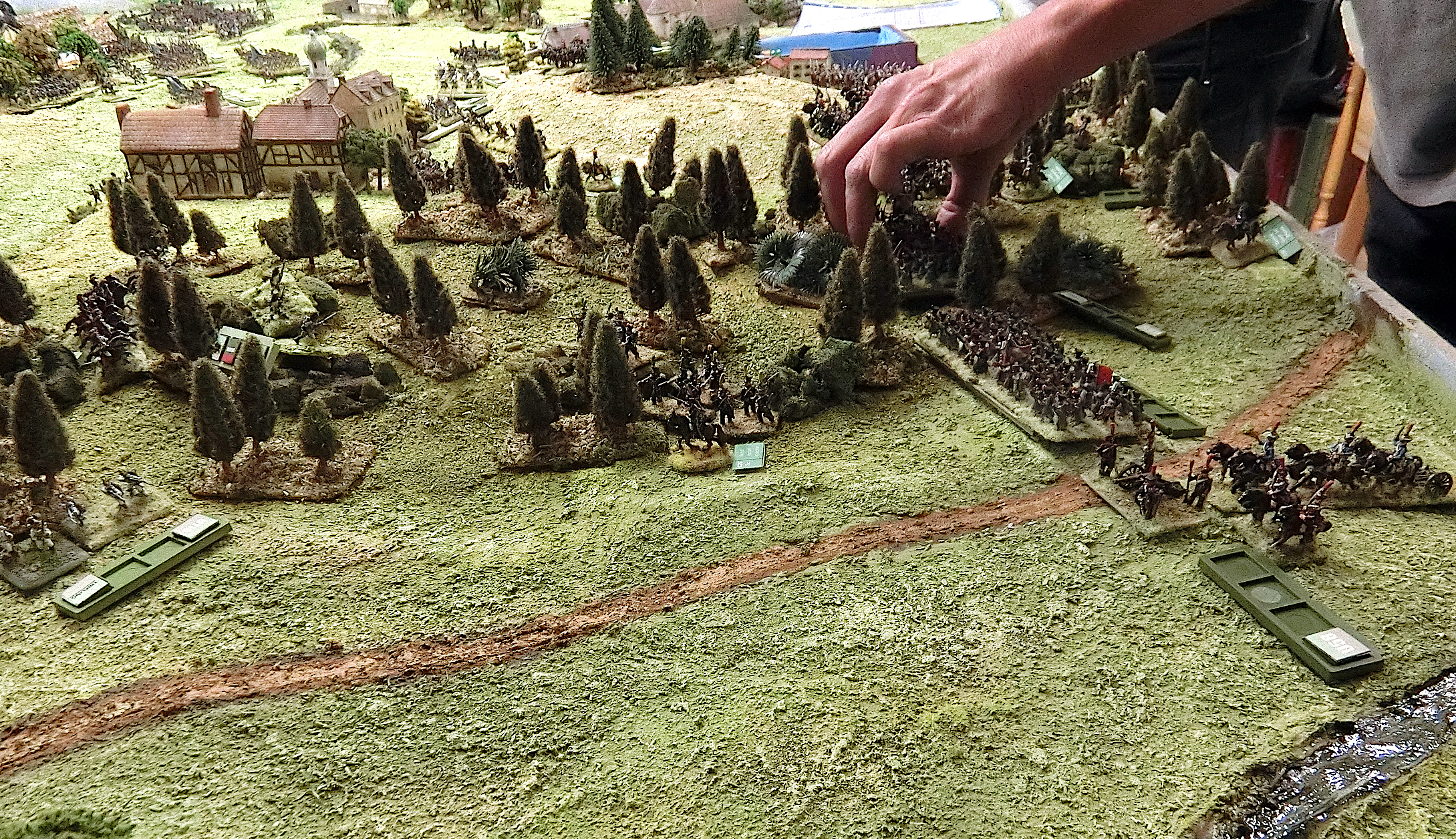
I'll leave you with a couple of photos taken from a batch kindly sent to me by Glenn Lowcock.