Wednesday, 23 July 2014

Waterloo Project: First Test game - Infantry and Artillery

I've made cryptic reference in previous posts to working on rules for our madness of refighting the actions around La Haye Sainte and Hougoumont in 1:3 scale next year. I drafted a set of rules, appropriately entitled With MacDonell and Baring, 1815 (WMaB for short), back in April but it took us till 17th June to assemble the gamers and a venue. In fact I had to have it at my present abode, commandeering the sitting room while the Duchess was away for the day and so the terrain is just cobbled together to make a space 6 feet x 6 feet 6 inches with a couple of gentle slopes made of basic boards and books covered in suitable green material. It's nothing like I hope to have for the real games, twice the size. Four of our 6 project members contributed - Kevin East took the French, and Richard Newcombe and James Fergusson the British, plus me umpiring. Being a rules test it was not so much a game more like "three blokes pushing around 1000 figures and talking a lot"! Consequently we didn't get any other result than a feel for handling such big units and the opportunity for healthy criticism of my rule writing.

The new frontispiece (above) for my blog gives you an idea of the spectacle when viewed from "mounted commander" level and this posting contains many photos of figures you'll have seen showcased on this blog since last Autumn, most in action for the first time.
My first photo shows the simple terrain - no it's not meant to be part of Waterloo but just containing some elements we will need - walled farms, hedges, orchard, woodland and slopes. The Allies had three companies of 95th Rifles on the table to start with, holding the far wood and both farms including the near orchard. the French brought on two battalions and a Horse Artillery battery deployed across the road. The allies reinforced with a similar battery deploying between the farms, and a large company of Nassau Voltigeurs on the right flank.
Testing the skirmisher rules James quickly advanced a company of Rifles from the wood to what is pretty close range on this scale.
Another French Battalion, this one has skirmishers out front .
The first French battalion throws out its Voltigeur company and the Rifles cheekily fire and retreat having taken a satisfying toll on the main column.
A third French battalion appears and is wheeling its Voltigeurs out to skirmish
A wider view shows the front battalion attacking a farm where Riflemen are lining the hedge and RHA give them some canister (not effectively enough - we changed the rules later). The farm had already been set on fire by French artillery fire.
On the Allied left flank James now brought on the 2nd Light Battalion KGL. Although a rifle-armed light unit I organised them in two wings of three companies each for this game.
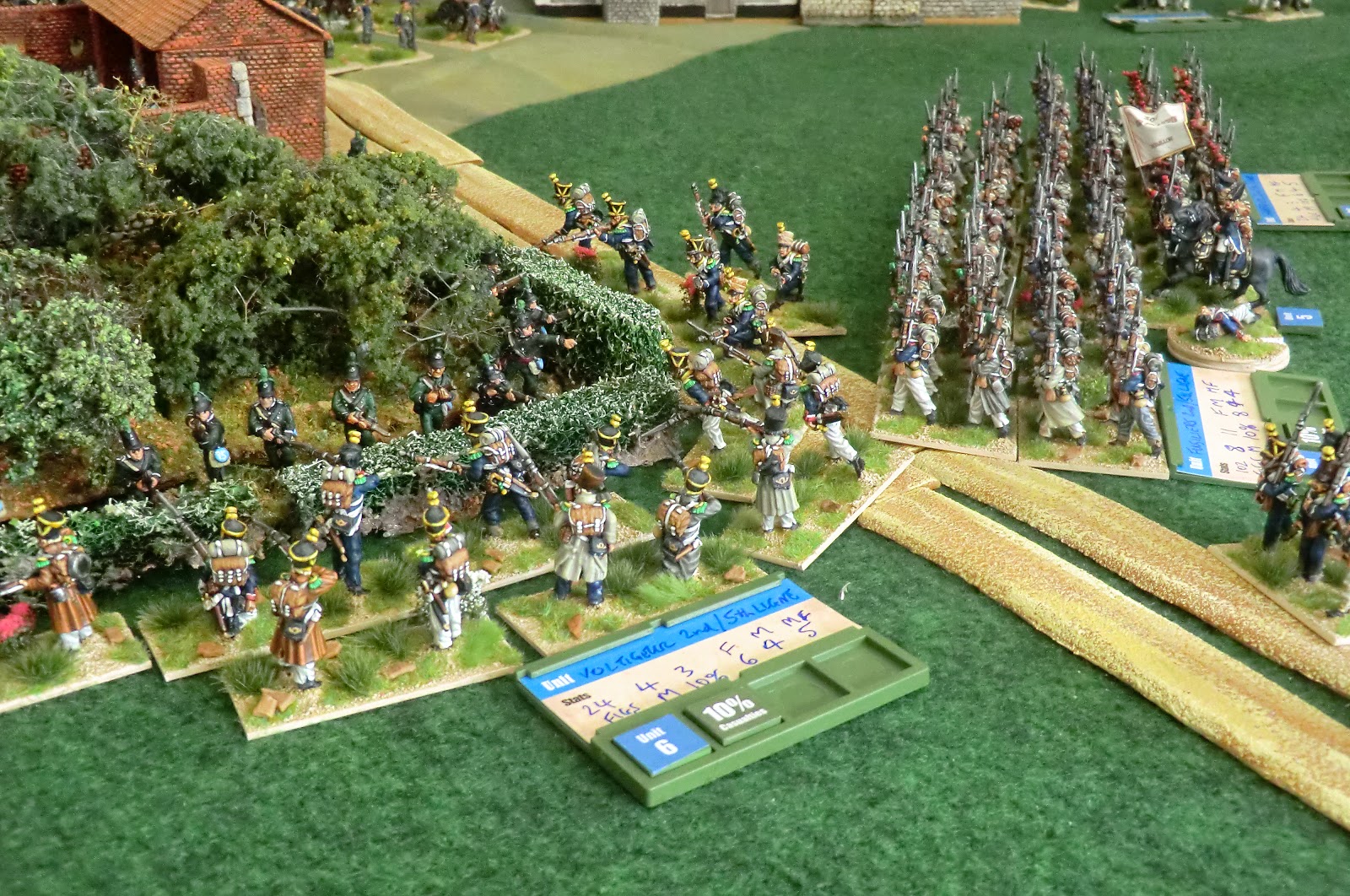
Although the rules don't favour skirmish troops in melee Kevin thought it worth his Voltigeur company trying to force the hedge from the Riflemen. At first it was a stalemate.
Allied reinforcements on Richard's flank in the form of a half battalion (wing) of British Line infantry.
A general view showing most of the table. French Voltigeurs engage Riflemen in the right hand woods. The farm building burns more fiercely.
A fourth French battalion makes an appearance in the near corner and Richard's Nassau skirmishers will have to look out. 
View from behind the Allied right flank. On the right are 30 degree round shot angles and a 10 degree canister angle. On this scale canister could reach across the table, given line of sight, but ball proved useful for a narrower field of fire.
This general view gives a good idea of one of the delights of gaming in this scale - the solid masses of 130 -180 figure battalions.
 The Nassau Voltigeurs have pulled back and formed line to face their new foes and French line infantry engage the orchard hedge and the farm main gate.
I was pleased how my special rules for pushing melees with reinforcing masses quickly broke any sign of deadlock. No more a few skirmishers holding up hundreds just because they are defending soft cover. Here the 95th began to yield the orchard.
A nice view along the line of French attacking columns
This view from behind the same battalion shows a significant close range engegement building up with 2nd Light Bn KGL.
Allied light and line troops prepare to meet the French with volleys. In the distance a Rifle company has made its withdrawal from the orchard.
British Royal Horse Artillery battery, though at present we are having to use some foot artillery crews and teams to make up the strength. French howitzer fire has now set the other farm alight.
The second KGL wing takes up a reserve stance while their colleagues reinforce the wood.
Finding he could not break down the farm gate quickly enough Kevin reorganised his front to form a column of companies led by his Grenadiers to attack te RHA battery frontally. The casualties suffered were not enough to repel the attack and we all felt amazed that the French got off so lightly. However, I explained that the canister angle (Charles Grant style) was deliberately narrow due to the very long potential range on the table, therefore at very close range like this not many figures are actually hit. 

We didn't have time to see the melee through but just before we packed up two of us had a play around with the line versus line musketry dual hinted at in one of the photos. That was a worthwhile exercise because it showed that casualty rate attrition, and subsequent morale checks, was too slow for gaming purposes so we made some fairly drastic amendments for the next game.

In conclusion everyone involved said how much they enjoyed the day; whatever the outcomes it was sheer joy playing with these large formations, and particularly for Kevin who has put so much loving attention  into his figure painting and basing. We'd spent about 7 hours playing of which probably about 4 was productive due to constant debate about the new rules, and some really useful amendments resulted, including the observation that we need to set up a test with attrition already taking its toll on morale. So, coming shortly .....the cavalry test game.


Wednesday, 16 July 2014

A Real Hussarette?

I'm currently reading Captain Kincaid's memoir "Adventures in the Rifle Brigade" and was astonished to come across this cryptic entry in the diary for early 1811.


Gosh, this gets the artist's juices flowing and all sorts of questions spring to mind. What a dramatic painting it could make having a body of 95th Riflemen, led by a dashing pelisse wearing officer taking prisoner a French uniformed aide-de-camp, and the "Hussarette" wife standing by looking rather shocked but "handsome",....err, well that means sexy to me, and what my Hussarette project started out for.

So does anyone have any more information on this? What kind of uniform would a Portuguese wear who had enlisted as an aide to a French General, and I think we could use a lot of artistic licence for the wife. Does anyone know their names?

Any patron of the arts out there care to commission me, and have a big say in the painting design.

Of course you could read the English differently to mean that it was the ADC dressed in the hussar uniform, but that would rather spoil the vision. I think an ADC would be likely to have a splendid hussar uniform and therefore not so worth remarking on as a woman wearing one.

All comments welcome, but please not anonymous ones.


Tuesday, 3 June 2014

Waterloo Project: 191 from Luneburg on the painting table

Kevin puts me to shame with his prolific output, (french-brigade-510) super detail and top quality figures, and so to try to keep my end up I'm just showing what is in store for me next. Unlike Kev's gourmet approach to his models, I tend to love doing my wargaming on a shoestring, so I have been accumulating the Hanoverian Luneburg Battalion slowly for about the last 8 months or so, bit by bit. In fact every time an opportunity came up  to buy some "British Infantry in stovepipe shakos" at a good price on Ebay, or cadge them cheaply elsewhere.

I've got all the figures I need now for our 1:3 scale representation and have mounted them and undercoated them in Army Painter "Army Green" spray ready for painting. Before I say any more here is an overall shot.


They are an eclectic bunch, but all judged by my eye to fit together on the tabletop. They started off when my art patron, Ian, offered his unwanted boxes of Victrix French and British to the 1:3 project. Shortly after that I bought a batch of Front Rank British Light Infantry from James Fergusson of Fergscalemodels. That eventually led to James joining our project and supplying lots of boxes of plastic figures to me and other members of the team at a good price. Some of those ex Ian and James Victrix Peninsular Infantry have found their way into the Luneburg ranks here. In addition there are batches of Foundry and Essex, and I've included a few Perry Hanoverian buglers and command figures. There was also an Ebay batch that looked a bit like old Hinchliffe style but bigger, so not sure what they are.

From my research it seems Luneburg was one of two Hanoverian "light" battalions but on the day was being used as a field (line) battalion so I've based the majority in 6s to ease that function.  Apparently it was composed of four large companies. But info also suggests that 1 in 3 men were armed with rifles not muskets, I assume that means within each company. At Waterloo 50 men were detached to join the Nassau troops defending Hougoumont, I'm guessing they were all rifle armed skirmish types. Followimg this logic my Luneburg battalion would still need a large quantity of skirmishers so I've based this first company in 3s using kneeling, firing and at the ready poses so they will adopt  "open order" more easily in our game.


The models don't have rifles as such but I've removed most bayonets and from a distance who will notice?

I've put the other companies together just in a pragmatic way that makes each one a bit different but hopefully looking as if they belong together - the full paint job will help that. More formal poses have been used, but even different manufacturers in the same company.


The unit is completed by a command stand of officers, musicians and colour bearers, and there is also a mounted Lieutenant Colonel, and four casualty markers. Our rules will allow for very varied sized units so I anticipate, on the day, this will be one  rifle-armed company of 44 figures, and a main battalion unit of 147 all ranks.

Now I've put these on the blog it's meant to spur me on to get them painted .....191 in one go is exciting yet scary. I've set myself a 3 month target for completion. Meanwhile if anyone has any reliable information on what the Luneburg colours looked like on 18th June 1815 please let me know, my colour bearers are waiting expectantly with bare poles ........(ummm, perhaps I should rephrase that!!)

Not sure when I will be brave enough to show these again but next time I will try to say a little more about their role in our La Haye Sainte scenario and why I think they are worth all this effort.

If you haven't found it already James Fergusson's blog is worth a visit Napoleonic Wargames blog.