Showing posts with label SYW. Show all posts

Monday, 7 September 2026

Bit of a catch up and an invitation

Yes, I know I've still got a couple of parts on the refight of Eckmuhl to blog, and thanks to those who've reminded me it's wanted. However I just want to give a quick taste of all the wargaming stuff that has kept me away from blogging for nearly 6 months (!). Please read to the end to see an invitation to join some of us for a game at Oakridge in the heart of The Cotswolds (not those chic fringes that are too near that London!) Very Soon.....

The "problem" (is an excess of actual wargaming a problem?) stemmed from wanting to use the basics of my nicely sculpted Eckmuhl table for lots of other games too. Building the Eckmuhl terrain last year

Many will have seen my first go was two 28mm SYW games in Feb and March  (Battle of Hohenburg).

After that in April I wanted to try to get my 10/12mm World War Two Russians and Germans out and imagined the terrain could be a variation of real events on the German approach to Stalingrad.  I called it the Battle of Hill 118.  Paul B and Dillon Browne were up for trying out my "Seb's Soldiers WW2" rules , which were sort of fit for purpose but converting rules for a 7 year old to suit two knowledgeable wargamer adults was not 100% successful. Here's a taste anyway.


Around this time Paul B made me aware he had a very nice collection of 15mm , mostly Blue Moon I believe, for the American Civil War. At my suggestion he agreed to put on a game if I remodelled the terrain to resemble an offshoot of the Shenandoah Valley for the 1862 campaign. Paul called in The Battle of Grenton and introduced me to the "Flames in the South" rules which uses practically entirely black and red dice (imagine for most things Red Die = Good,  Black Die = Bad - like old school 4,5 or 6 better than 1, 2 or 3). Various activities require different numbers of red or black dice results. Combined with a token system  for Generals' interventions, and some minor chance cards for variety it gave a very fun, yet realistic feeling game.  We were joined by another Cheltenham resident , but newcomer to my Oakridge den, Iain S. See what you think of the look:

Lots of blinds to start with 

Iain is an eager wargamer and quick learner

Well into it now 

Stonewall Jackson (without the beard) points to the scene of his success

Still a lot of Yankees on the ridge to frighten with my rebel yell!

Near the end - Union left flank is totally crumbling in the foreground

Could it have been because my Confederates won in fairly spectacular fashion (no disrespect intended for Iain , my plan was sound and I was lucky at the right times) that I got a bit excited afterwards? But we both enjoyed the rules and the troops (and the terrain) and I was inspired to think I might relieve my ACW refights from the 6mm days of c1995 to 2010 and so I'm now the possessor of around 700 or more ex Ebay, painted ACW figures to get ready to join Paul B's for something much bigger next year.

Iain had come to me, as a relatively near neighbour, who could help his revived wargaming post retirement surge, and introduce him to the joys of "Honours of War" for his  recently acquired large SYW armies. First he needed a training scenario. As luck would have it Dinos had the very thing needing testing with a genuine newbie, in planning for his next HoW scenario book. So I used parts of my 28mm collection and the southern part of the old Eckmuhl battlefield as a 6 x 4 area for "Attack and Defence". I've agreed not to blog that till Dinos has published the book, so keep watching this space.

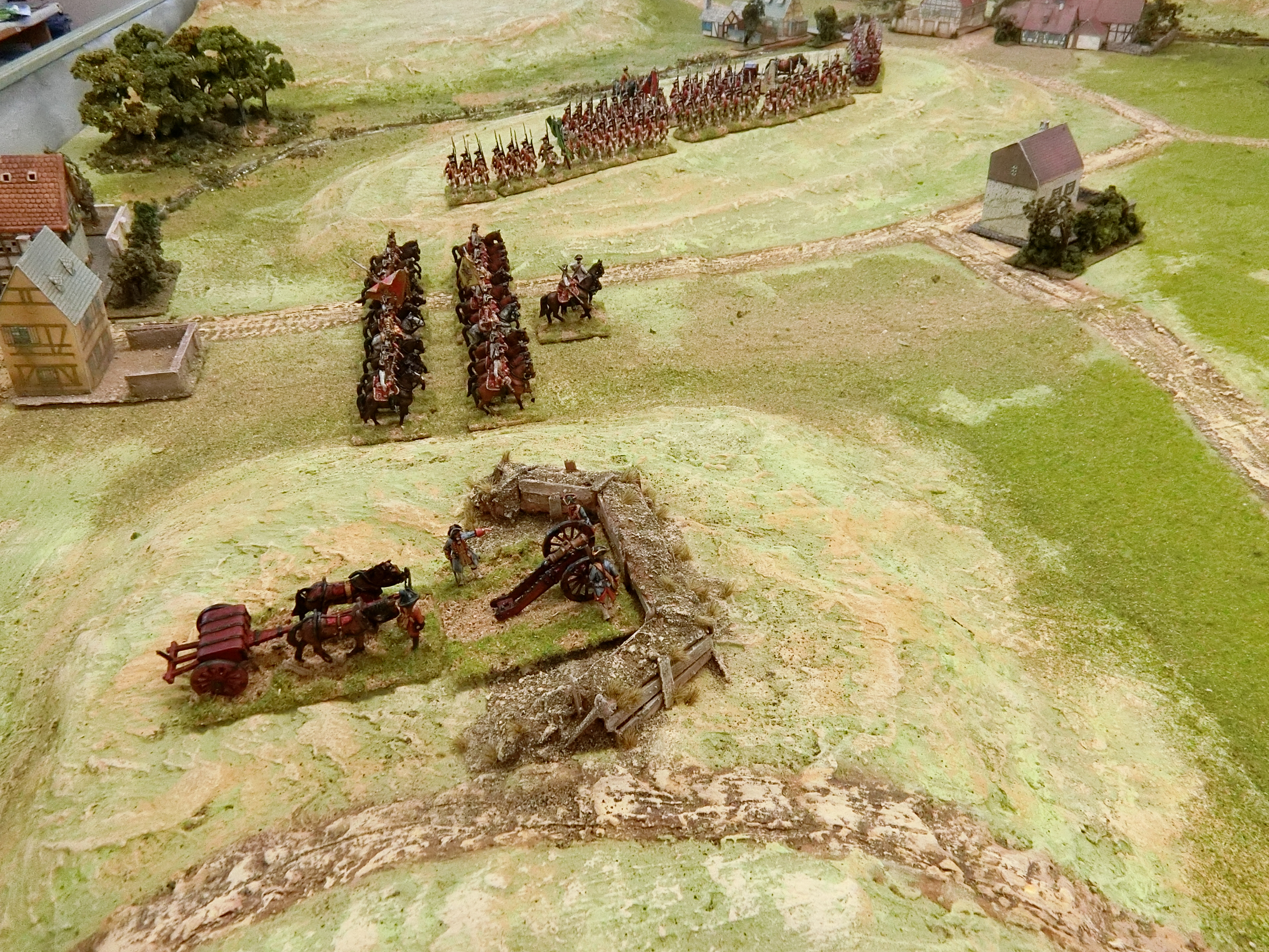
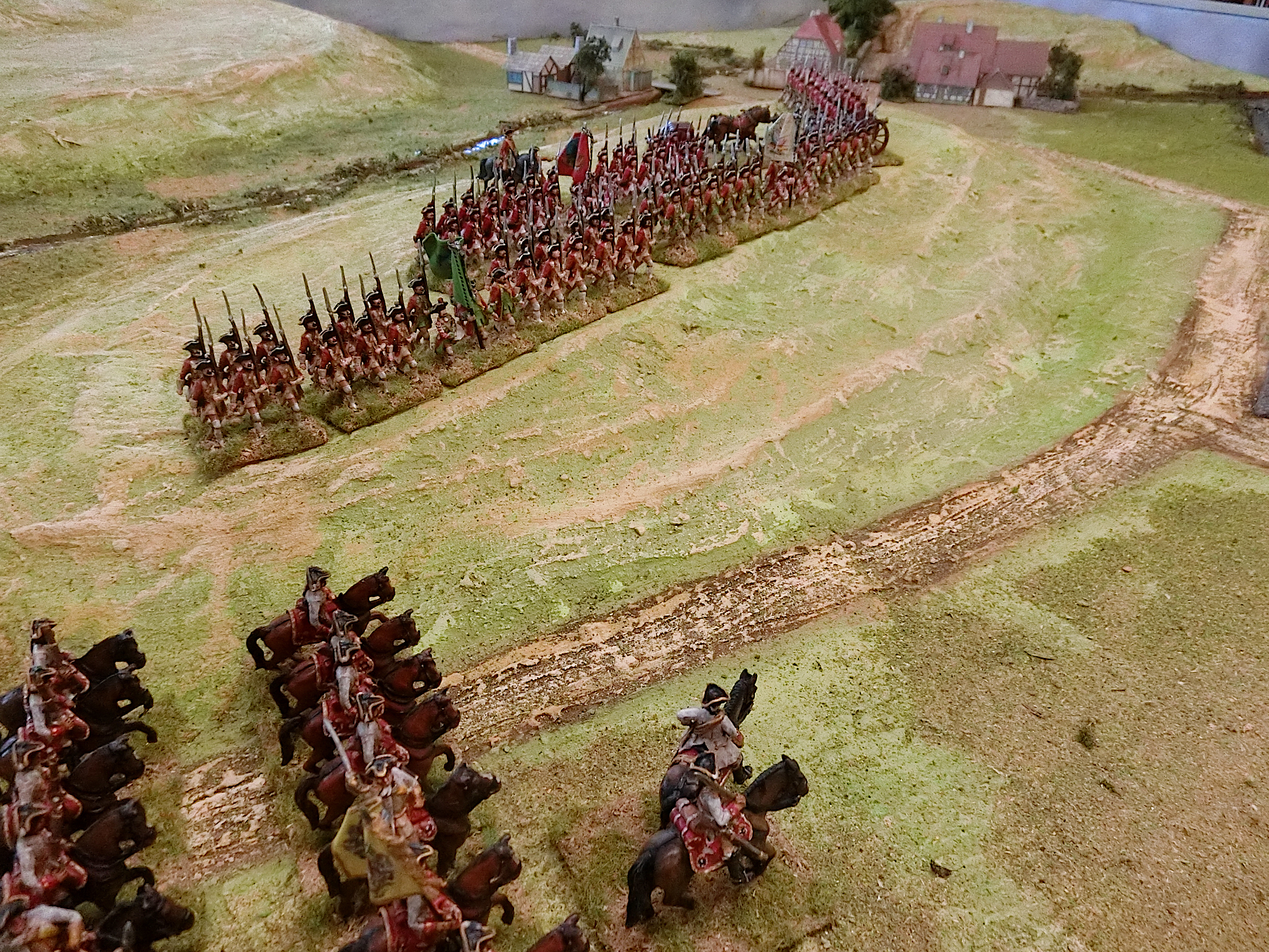
But I can show you the next game and I really enjoyed redesigning the table for this one. Not using the two feet nearest the window but reinstating the marshy valley from Eckmuhl with a couple of ponds too, for good measure. I also was relatively fresh from our holiday in the Baltic States in May. I was completely enamoured by Tallinn, Estonia  - various hilltop church spires and castle towers joined up by almost complete Medieval city walls - I just had to have a bit of that, and so got the gloop out afresh to blend in city walls on a steep slope for gun batteries and ecclesiastical building boundaries! As stated, Iain has wonderful 15mm SYW armies and we used most of his Austrians and Prussians here.  I looked at history and mucked about with a campaign in Saxony in October 1758 where the town of Lobauburg was passed through by Daun's Army shadowing Frederick's over the Lobauerberg mountain. I set the scene for an imaginary Prussian holding action on the Lobauerberg.


Hot action on the table and it was hot in the room too!


Much to discuss near the end of the action. Iain's Prussians had lost a lot but held firm. 

That was mid-July. For mid August in my exhausting re-modelling schedule, it was back up the scale to 28mm and two more of Paul's magnificent collections. For this one he asked me to transport us to a supposedly Merrie England of 1654, where  King Charles still battled on, aided by Prince Rupert and the Duke of Buckingham, with French Royal Army mercenaries too. They faced a combined enemy of mostly English Parliamentarians but with Allies from the Orange Protestants of The Low Countries, all under Sir William Waller. Two collections because his ECW armies were mixed in very successfully with those of the Franco-Dutch wars of the 1670s. The scene was the rural villages of Tumpington and Brewood, with Tumpington Manor being one objective, but dismembering the opposing army was more important. Paul used "An Uncivil Affair" rules - the ECW variant of the aforementioned red dice, black dice system. Iain S. and I were the Royalists facing Dillon Browne's Roundheads with those austere and dour Dutchmen to help 😊.

I used some arial photos of my redesigned table to feed into the Nightcafe AI system and eventually got a pretty accurate output reminiscent of J.R.R.Tolkien's "The Shire"


The glowering, serious expressions were not typical, yet this was a game with many challenges for us all (I was King Charles) and with many hard nosed charges by both sides. It was an "Uncivil Affair" in name only and we all found it enjoyable and satisfying.  Maybe another one next year. (No captions for this set as, inexplicably to me, Blogger joined all the photos and deletes one photo if I try to write a caption!) 

And now for The Invitation

I hope you haven't been bored by all the variations on essentially the same tabletop as we have another one this coming weekend - but very different. James Fergusson asked for a chance to refight a Peninsular War battle.   So I've remodelled bits of it to make the two famous hills at one end and extend the long ridge at the other and we are all set to refight Albuera 1811 on Sunday 13th September at 1:50 figure/man scale and have the whole 5km battlefield in our 10 foot x 6 version. So around 1500 x 15mm figures mainly from James' collection but also Richard Newcombe is contributing, and I'm filling some gaps from my cabinet too. This is the one where Beresford commanded a joint British and Portuguese army with the Spanish working in close alliance (for once!) and used the terrain to try to thwart Marshal Soult breaking through to the Siege of Badajoz.

We have 5 players and two umpires but really need a sixth player to balance out on the French side. If you fancy joining us for the day and can get to Oakridge Lynch, halfway between Stroud and Cirencester, in Gloucestershire, then please email me (Chris Gregg) as soon as you can. I'll send anyone serious the precise location and rules and scenario info. We will be using my Napoleonic version of HoW called Abensberg to Wagram (A2W) which has just a few changes since Eckmuhl and here is a link to the current documents A2W 2026 version

Meanwhile here is a taste of that Peninsular stye battlefield:

Not many features compared with all the foregoing. Bare hills (in reality covered with arable farmland)  mostly dried up river and streams, some key roads to squabble over, Albuera village and adjoining orchards, and olive groves with small grape vines


3D printed buildings make up an interesting Albuera which should feature prominently in the game 


A boring photo, but those open hills should give plenty of tactical and strategic scope for a good wargame

So have a look at some figures - not in any way placed for the battle just for bit of scale and atmosphere. Each tactical unit is brigade size or an artillery battery


I hope you've found this snapshot of my last 6 months interesting. I intend to blog each in much more detail as time permits. And we haven't finished with it yet! JP of Youtube channel fame is back and he plans to organise one of his famous 28mm 
Napoleonic games on yet another variation in mid October.

best wishes
Chris G

ADDENDUM

James Fisher's very kind comments below have encouraged me to finish off with a couple of photos of our Albuera game.

All the players, and James Fergusson as Umpire, in action as the Allies scramble early on to meet attacks on both flanks and in the centre

Nearer the end the Spanish and Portuguese are mounting a counter-attack(!) South of Albuera village, which the British still hold ...just.


Friday, 13 May 2022

The Battle of Madling 1753: Part One - Introduction and making the battlefield


Background

In the previous post I outlined three weekend games we have planned here at my humble Cotswold retreat. The first one was to be Wiltshire's Ken Marshall organising the next episode of his Imagi-nations campaign between the mid-German forces of "The Electorate" (a bit like Prussians and Hessians) against the equally formidable "Ducal" armies (white coated Austrian types with Hanoverian style allies), and we had now advanced to October 1753.  I decided we would use the standard 8 foot x 6 foot table and my contribution would be custom sculpting whatever terrain Ken wanted.  The date for the game was set for 23-24th April and we ended up with 3 other players and me, with Ken as umpire, on the Saturday to play out a fight for territory between the two substantial Advance Guards. The Sunday brought two new players and the main armies to try to decide the issue. 

I was amazed how Ken's collection of Minden/Crann Tara/Fife and Drum 28mm figures had grown - to about 1600-1800 figures I think. In addition we called on a few hundred of mine and about 400 - 500 from Paul B of Cheltenham.  I was worried this would be too many for the table but Ken felt confident a lot would be overcome by attrition on the first day, nevertheless he had to ensure some substantial forces for the newcomers to command on Day Two. As those two were "Honours of War" creator Keith Flint and his play tester Steve Johnson, we wanted to put on a good display.  So you will have to forgive the toy soldier megalomania which made manoeuvring room at a premium but wargames eye candy at the maximum. I hope you agree - here is a glimpse of what is to come:

Paul and Keith are having a serious advance with the Ducal army while Steve J tries to distract us all with his good natured banter

Yes it got a bit crowded but "Honours of War" can stand that. Retreating or fleeing through masses like this can take its toll.

No shortage of cavalry action in the centre and far flank

Anyway, much more of that later, this post is mainly about making the battlefield and a basic intro to the game.

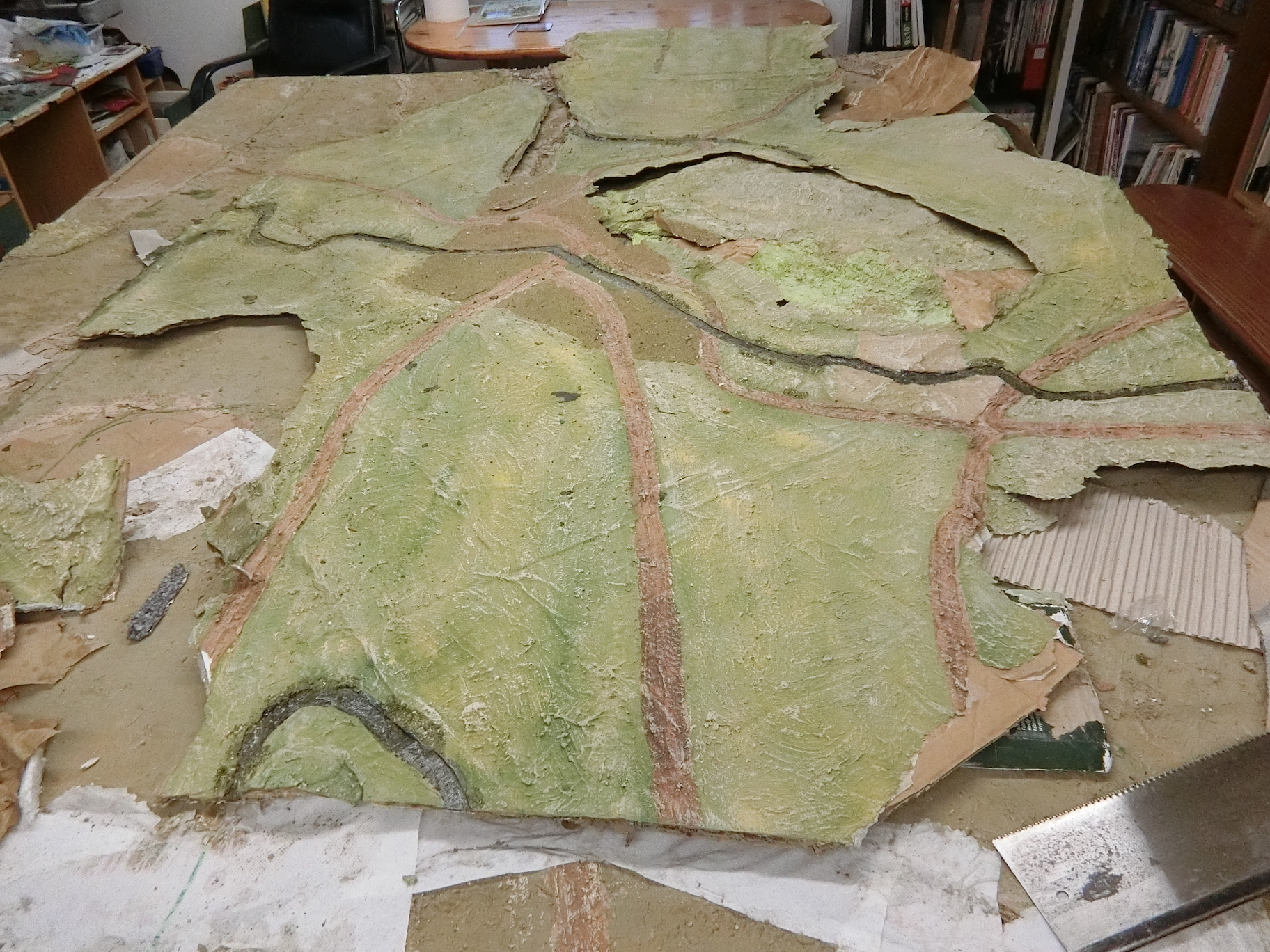
Dismantling the previous sculptured table top

For those who have lamented the demise of my previous "art installation" terrains, don't worry, not much goes to the local tip, most of it is recovered and reused in different guises. I will start off with some photos of dismantling the previous Langensalza terrain in January.

Releasing the cardboard base from its bed on top of the
old Brampton board
Recovering hills and useful textured surfaces for storage and
future re-use or adaptation

Creating the battlefield for the Battle of Madling

Here is a look at Ken's sketch map which he sent me as a starting point, together with a description of the kind of terrain he envisaged


And this is the version I made of it in Adobe Photoshop to use as my scale guide for the build. (I don't have the full pro version but I find Photoshop Elements 2020 is adequate for my needs and affordable to buy). 
It looks like I must have decided unilaterally that the corner high ground in A-B8 was to be steep!

I will describe the stages in making the table from start to finish by photo captions. Most of the methods will be familiar to my regular readers and apologies if I bore you. However, towards  the final stages I did things a bit  differently. 

I used large surplus cardboard packaging to give a fairly flat surface.
Joins were sealed with masking tape covered with PVA

Reclaimed hills were used where they were the right size.
 Elsewhere flat pieces of textured surface  were stacked to make a
 roughly stepped hill or two which will be smoothed out a bit later.

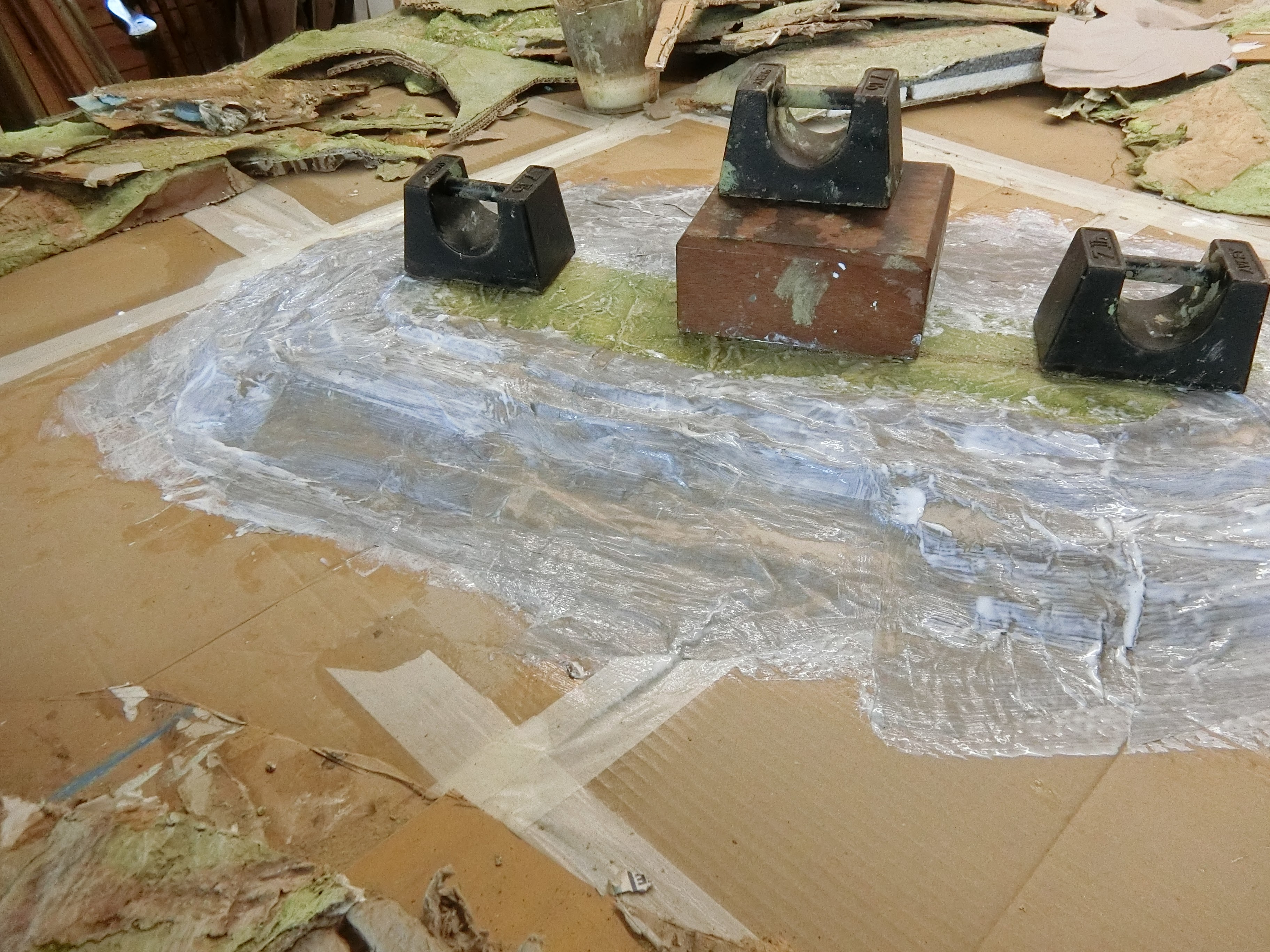
Smoothing out first stage with papier mâché and PVA

Weighted down to prevent warping while it dries out

More hills cobbled together from pre-loved pieces and masking tape
before the papier mâché coating (below)


Here is the high double contour corner piece in process

Checking my construction map I realised i had made the Rosenkranzhohe
too big!! I had to get the saw and make a drastic change.

Now the hills were in place I sketched in the roads and rivers with marker pen and thin acrylic wash


If it is thick enough (about 3-4 sheets of paper) the papier mâché and PVA dries to a satisfying hard surface

Time to use a heavy, sharp knife to cut out the streams and river
 to make use of the natural recess depth of the cardboard packaging

Then blend in the stream banks with more papier mâché

Treatments begin to get more optional now. This time I have used a thin mixture of builders plaster to coat the stream and river beds as an undercoat for colour

While that is drying I can get on with a big job...

.....coating everything except roads, rivers and BUA areas with various green textured gunge.
This time I just used builders plaster, sand, acrylic or commercial matt emulsion paint, and water.
No sawdust, small stones or PVA glue. Omitting the latter was a mistake.

It looks quite nice though, and does help to blend in those stepped slopes

Not really deliberate but the greens turned out differently due to different mixtures and running out of some shades part way through. As an artist I tend to play it by ear and use what I have, adapting as I go along.....let's see how it dries out

Applying a dark mixture of paint and PVA to the stream beds

Brown plaster and sand mix helps define a cliff line and paths on the very steep hill.
A similar mix is used for a base coat for all the roads

River beds and roads all blocked in now with base coat mixture - textured for the roads, smooth for the water. A simple brown and/or sand/PVA coating for the built up areas (BUAs)

When it was all dry and hard I went over the entire surface
with my surform tool and ground away at the little nibs of hard sand or plaster.
The idea is to keep texture but not so much that it is ugly or difficult to put troops on.

The residue can be swept up and stored to be used for something else

A thin wash of dark brown acrylic paint fills the ruts made in the plaster roads

I used a dull brown runny mixture of paint and PVA
on top of the dark river beds. There are no right or wrong ways here BUT,
rivers are only blue when you are so low down on the bank as to see the reflection of sky.
If you are flying low in a plane, helicopter or air balloon have a good look down on the rivers

While it was still wet I introduced more dark paint nearer
 the centre to represent a deeper depth of water  

I like to work across the whole area with different effects to keep it in all in mind like a landscape painting. So now I have done some lighter dry brushing to bring out the high ground better

But then I extended that treatment to the low areas too, and to the casual eye it all looks similar. Some might be happy to leave it there.

Keeping at the dry brushing with slightly different combinations of colours. Over the days I noticed that these greens take on quite a different hue if photographed in daylight or under the strip lights we  normally use during a game.

I used a nice warm cream as a dry brush for the road network.
You can also discern the slightly varied dirty water colours

No PVA in the gunge....the plaster drying out had caused
some cracks where my cardboard joins were.
I used sawdust and artificial grass mixtures to try to disguise it

That led me on to something I've not done before - the wholesale spreading of static grass and sawdust combinations over all the low ground areas. My idea was to make it look like well watered productive pasture land, and leaving the high ground bare to look a bit more like moorland heath. 

Quite pleased with this result. These two views of the same with different lighting

I used dried or burnt grass flock for the very highest contours in each corner. Lots of areas of the world have brown grass where the soil is thin and well drained such as rocky moorland or plateaux.

The roads have yet another lighter drybrush and I'm putting some terrain features on now.
The redoubt has to be very old (Thirty Years War) falling apart and overgrown by weeds.

I pre-made the bulk from air hardening clay and stuck some coffee stirrer bits in it.
I stuck that in place on the hill then more wooden stakes and a mix of sand and flock effects.

Looking round the finished battlefield

The above sequence is effectively the end of the "how-to" part as I seem to have got carried away with finishing the detail and adding the woods and buildings and have not taken any specific build photos. So what follows is a look at certain parts that might be of interest and then the overall effect.

First the finished redoubt. All the loose stuff was brushed off then dry brushed with cream acrylic. Adding tufts for weeds completes the tumble down look

Two views of the Village of Madling. All the card buildings are reinforced with balsa wood and are removable for putting troops in the BUA, but hopefully have a lived-in sort of look. I did not get round to weathering the card models before our game but I have since!


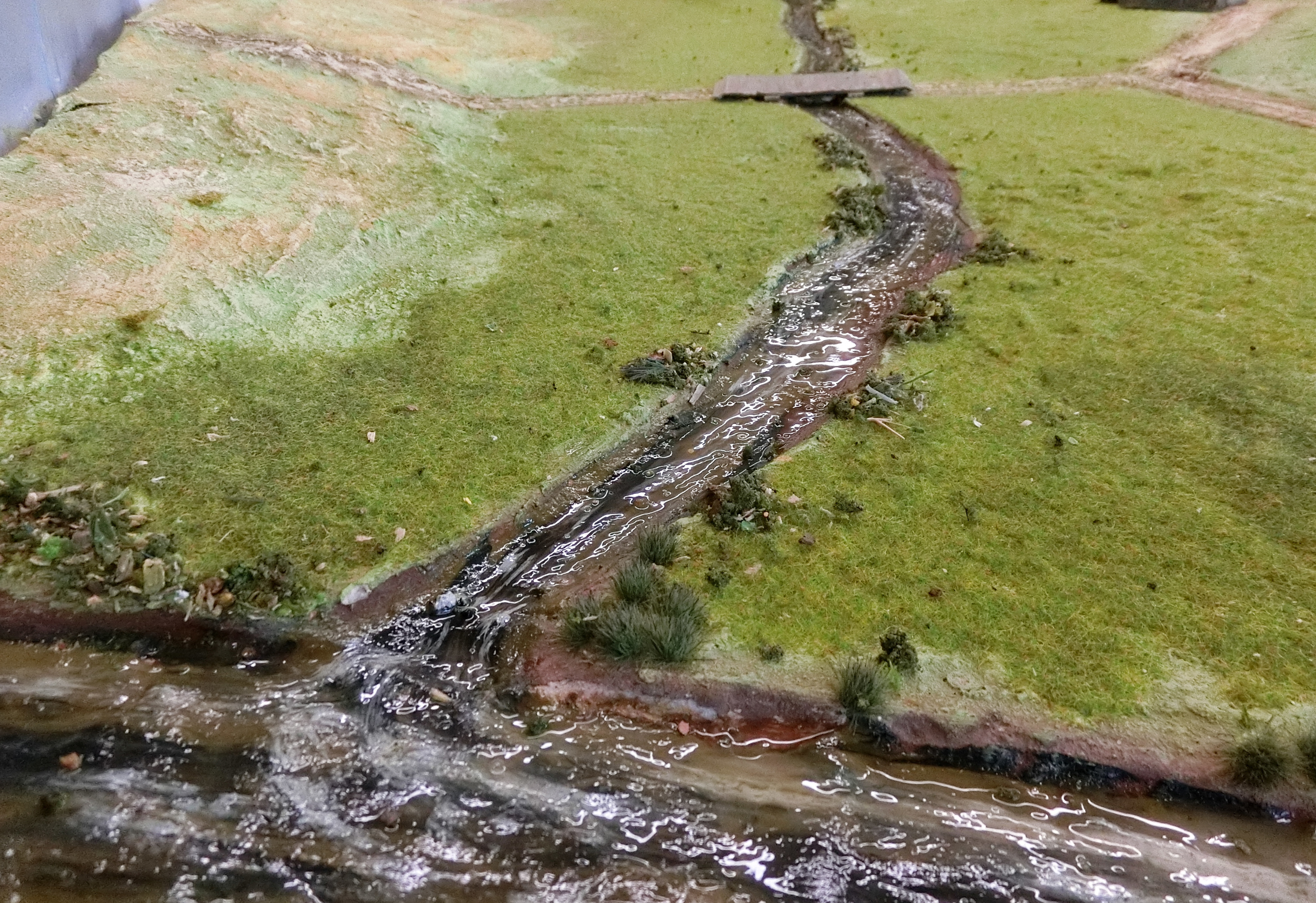
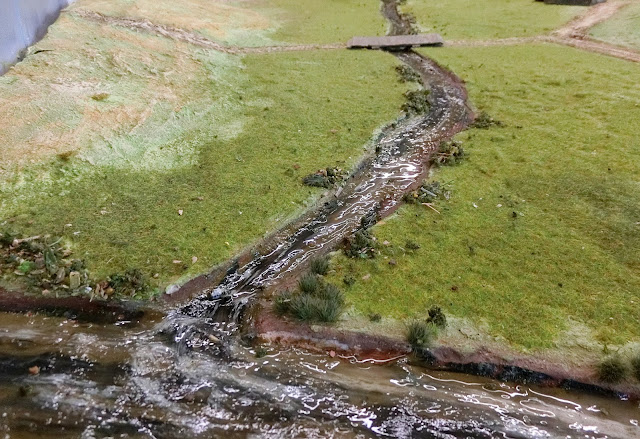
Close up of the Stronbach river and Lunzenbach stream. The previous paint was finished off with light dry brush of white and when dry was coated with up to 5 layers of acrylic gloss varnish. 

View showing the transitions of surface textures from the basic painted terrain through static grass/sawdust finishes, and all the streams were judiciously edged with my general mixture of green foam scatter and commercially bought tufts. They help offset the stark look of the cut-out cardboard river banks

Kaindorf in the foreground

The hamlet of Mauthaus


Looking down on Lunzen from the high corner moorland with cliff edge and paths. Covered with dry grass in two or three colour combinations and "winter tufts" to mark the paths.

Finished effect before the soldiers arrive

Battlefield as parade ground

I wanted to give the players an idea of how big the units are before the day to help their planning. So the following is a further look round in the company of my small, but growing, Hanoverian army.


The overall look with an "Honours of War" brigade of infantry and one of cavalry, and an independent battalion of Jägers garrisons a forward hamlet. By now I have refurbished the grey cloud/smoke backdrop which sets off the terrain nicely and is multi-use. The how-to on Making trees I did a year ago.

I will finish off by giving you a taste of Ken's Imagi-nation campaign. We pick up after the battle of Stadl an der Mur

The Mur Valley Campaign – Madling, October 1753. Electoral Outline

"1753 – The Elector has tired of the long period of peace between the electorate and the Grand Duchy. Whilst it has been useful in allowing him time to rebuild and train his army, the time has come to further his territorial ambitions by seizing the Mur valley from the Duke.

The annexation wasn’t as easy as the Elector expected. The Ducal army reacted swiftly to the invasion and successfully halted the electoral advance before Tamsweg. The campaign has degenerated into a war of outposts as the two armies struggle to gain an advantage and the fear of failure overcomes any martial ambition or initiative by the two commanding generals.

An attempt last month to outflank the Ducal forces at Stadl failed and the appearance of unidentified foreign regiments at that battle confirmed intelligence that the Duke was being supported by a coalition of neighbouring states who have also suffered from the Elector’s military ambitions. Although coalition forces have not been committed to the fight anywhere else, it can only be a matter of time and the army is likely to find itself heavily outnumbered.

The Elector’s generals now await the arrival of winter and an end to the campaigning season that will allow them to consolidate on their gains in preparation for a resumption of the campaign next year.

The message from the Elector is clear. There can be no more failure after the Stadl debacle. The army will not give ground and lose the territorial gains made. Several of the generals whose performance particularly displeased him at Stadl are now residing in the Electoral prison at Oldenburg and he has made it known that there is plenty of room for more to join them. "

In outline  - The Electoral Commander, von Stuttenheim is defending everything to the East of the Stronbach. He only has two brigades of mixed light troops at the start and the Ducal Advance Guard is expected to arrive from the Northern baseline...............

Steve and Kevin conceal most of their defending troops ......not much to see

......until Paul's Ducal Hussars and Grenzers hit Lunzen farm like lightning and the defenders are revealed.


A lot more next time.......

(PS Please feel free to comment but my replies might be delayed due to a pressing commitment away from the computer)