Showing posts with label Crann Tara Miniatures. Show all posts

Saturday, 3 February 2024

Graham Cummings - a Giant among classic wargamers

 I'm genuinely overwhelmed by the news I read on Facebook tonight that Graham has died. I did not know him well but well enough to consider him a good friend. Others who knew him better will no doubt give their own eulogies but I can only tell like it felt for me.

Graham cracks a light hearted quip with Dillon as they battle outside the Jacobite camp on the Isle of Vestisle - Oakridge, Gloucestershire, Summer 2019

I joined John Ray's new Forum "A Military Gentleman" in 2014. I began to join in posting stuff - particularly from my blog where I was reporting games and making models and we were preparing for Waterloo at 1:3 scale here in the Cotswolds - 300 miles from Middlesbrough/Redcar where Graham lived. Whenever I posted, one wargamer was constantly supportive and offering praise and advice, and that was Graham. I found out he was the founder of Crann Tara Miniatures and specialising in the 1745 Rebellion and the War of the Austrian Succession period...the figures were lovely and I began to buy more for my own Imagi-nations collection.  Members of AMG got a discount and personal service and advice from Graham.  In those days I used to scratch build models to sell  and I specialised in Windmills, which was a gap in the market back then. Graham showed interest and I made some for him to chose  such as this one , and he had two!

Time went on and there were many more supportive comments from Graham. I began to realise he was well known over many years to this group of "classic" or "old school", mainly 18th Century wargamers, which I had stumbled into. Graham organised a gathering and two wargames of the AMG group at Partizan in 2015, but I wasn't able to attend (though "my" windmill did!).  Not long after that he asked me to do some artwork for him to use for his Crann Tara company.  This was to be an iconic line of Highlanders charging the viewer. We collaborated frequently over what was required and he got me into watching "Outlander" for inspiration of authentic Highland Jacobite costume. (Jane and I got hooked - now into Series 7!). I paid one of the young lads doing gardening work for us at the time to model for me as he had the rugged looks I needed for warrior clansmen.  I discussed the rough ideas for the drawing with Graham at our first meeting in June 2016 - at the AMG gathering at Kenilworth in the English Midlands.  Graham is in the first photo of this part of my report on Kenilworth 2016

I need to digress a bit here to point out what a stalwart of our hobby Graham was - he organised this first "convention" of 18th Century wargamers which was a great success and is still an annual event for many. Besides Graham I met a lot of well-known names on the "classic" scene and many of them you'll have seen on my blog over the years, some coming to Oakridge to suffer my wargaming hospitality!  This was a life changing event for me - so much of what is good about wargaming for me over the last 8 years was because of Graham's entrepreneurial skill and sharing spirit within our hobby, bringing us together.

He approved my ideas and I did the drawing he wanted which then became the banner for the website of Crann Tara Miniatures. I also designed the broadsword logo.  I thought it would make a good oil painting and he agreed. That set me on a road to do more research under Graham's advice and figuring out how to make those varied early tartans look like 3D in oil paint. Some of you might be familiar with this painting if you saw the banner behind Graham's stand at wargames shows or got it as header in update emails from CT Miniatures a few years ago.

I was very pleased with the result and it was the kind of collaboration with a knowledgeable client that I love to do.

Graham also organised Kenilworth 2017, and in that year "AMG" switched over to become the "Wild Geese Wargamers" for reasons I need not go into here. I got to meet Jim Purky for the first time then who of course, gave us Fife and Drum Miniatures and acquired the Minden range which, working with Graham's Crann Tara, ensured we 18th Century nuts were well served with top quality figures. Highlights were playing alongside Jim in Colin Ashton's Leuthen 1757, and participating in Graham's own version of Falkirk 1745, using his "Teddy Bear Fur" terrain and CT armies of Jacobites and British.

You can see Graham umpiring Falkirk in the first couple of photos here

The next landmark event was in 2018 when I was able to take a  holiday in North Yorkshire and Jane and I went to see Graham at his home in Redcar. We had a nice long chat about his wargaming experiences, running a model soldier company, participating in blogs and forums, etc and getting to see some of Graham's latest master figures in pre-production mode. He gave me a copy of Neil Cogswell's "Zweibrucken in Command" about the Austrians and the Reichsarmee's exploits in 1758; I learned that  Graham had been instrumental in helping this series of super books to be published in the 1990s (now in new editions by Helion).  We also found at that meeting a kindred interest in trying to produce cost effective armies of Seven Years War Austrians and Prussians in 1:76 scale - true 20mm. Though it was discussed for a couple of years by email, and Graham produced sample castings for me to comment on, this did not get off the ground before Graham sold Crann Tara to Caliver Books. By then he had got very interested in designing figures by computer modelling and producing masters as 3D prints - ground breaking even those few short years ago, but now a mainstream activity.

Graham added to his fame in my eyes around this time by participating in some historic refights with Charles S Grant, and for whom he was making figures which featured in, among others, "Refighting History - Volume 7 The Seven Years, War Western Theatre". 

The real highlight of our relationship came in the Summer of 2019 when I managed to entice Graham down to the South of England for a weekend participating in our alternative history mini-campaign "Raid on Vestisle". He took the Jacobites (of course) and saw off some very tough Hanoverian opposition. He brought a touch of class to our proceedings (I'm sure Ken and Guy will agree) and we all enjoyed a good natured evening over a meal at the local pub and bottles of red while we pursued the campaign admin between two big day-long games. Here are the reports with Graham much in action on the French/Jacobite side, and playing a blinder on Day Two as well!

Battle of Bellune Hill

Battle of Abrantes

Graham operates the French left flank in the fictitious Battle of Abrantes, 1756

There was so much more to the man than I can ever know, all I can do is record my interactions here and pay tribute to someone who brought me so much pleasure and support, and I'm so sorry I knew him for so short a time.

Monday, 12 December 2022

Battle of Althorp - 26th December 1745: Part Three - Boxing Day Desserts

 I hope you have enjoyed this short series so far. If you need a reminder of this, the biggest battle in Guy's "what-if" Jacobite Rebellion, the previous part is here.

(As before - main text by Guy Barlow, explanations in picture captions, and helpful asides in italics (!), by me)

Day Two

The first five moves  on this mid -Winter "Boxing Day" had taken us from 8am to mid morning, but with 1200 figures for the two players and their "umpire-assistants" to deal with it had taken us all of the first day 's play to get that far. "Bonnie Prince Charlie" for that Day One was Ken Marshall who could not manage a whole weekend this time.  So Steve Johnson came up from South of Bristol for the day and picked up the Young Pretender's "Crown". 

At this point the Scots/French force, though it had suffered a lot, was gaining momentum and merely lacked overwhelming strength in any one sector.  Richard/Duke of Cumberland was defending well but his line was shrinking. Guy and I had to figure out what to do about the reserve brigades we had lined up for each side. With Steve/Prince Charlie obviously wanting a good game I was in favour of bringing the French reserves on very quickly so he would have the confidence to attack. To balance this I proposed that Cumberland receive a message telling him his reserves had been delayed and suggesting that he save the army by an orderly withdrawal. Knowing Richard of old I guessed he'd make a professional, well controlled and 18th century style attempt at this while being heavily pressed.

Guy had other ideas though, and he wanted to prevent an outright victory for either side in order that his campaign could continue on to his desired dénouement somewhere nearer London. So Guy wrote two hand written messages (see them here) which we gave to the respective commanders, who obviously had no idea of our actual deliberations. Neither did I really, as Guy kept his "neutral" intention close to his chest and trusted in the players' interpretation of his solicitor-speak letters and the fate of the dice! He knew neither side would get reinforced today!

CG

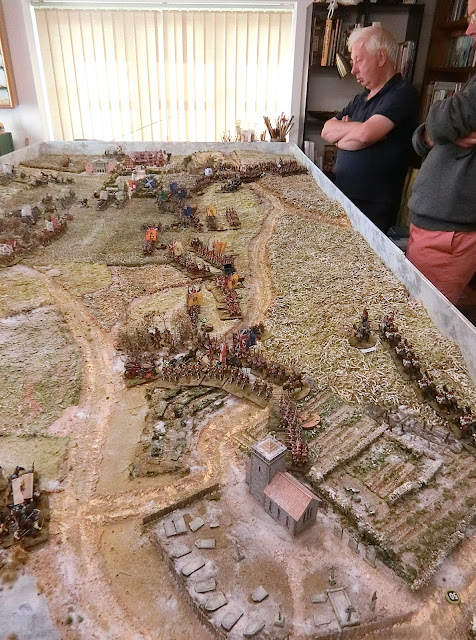
View near the start of Day Two, a detailed tour in the photos below
No matter how "serious" the game it seems to be laughter all the way when Steve's at my table!

The government left flank cavalry had either died, fled or were just retreating disconsolately. The villagers of Harleston were now the last bastion holding the flank!

The line of regular troops ended at Harleston Church with a worn Grenadier battalion

Reforming government units form the second line near Duke Ferdinand of Brunswick's left-central position

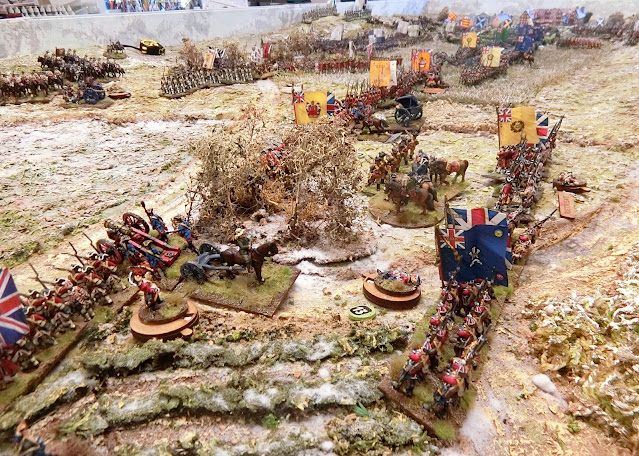
On the other side of the frozen village pond some Highlanders are eager to return to the fray, but behind them other battered clans are collecting muskets and reforming. In the distance small cavalry units are using the sunken lane to shelter from artillery fire while the two French line cavalry regiments are brought up. At this point they face a very thin-looking British defence
At the government right-centre the "Advance Guard" which had come on as reserve and moved towards Althorp Manor, has been withdrawn to form a second line and hold the flank. In the Manor Garden the mortar battery is under attack
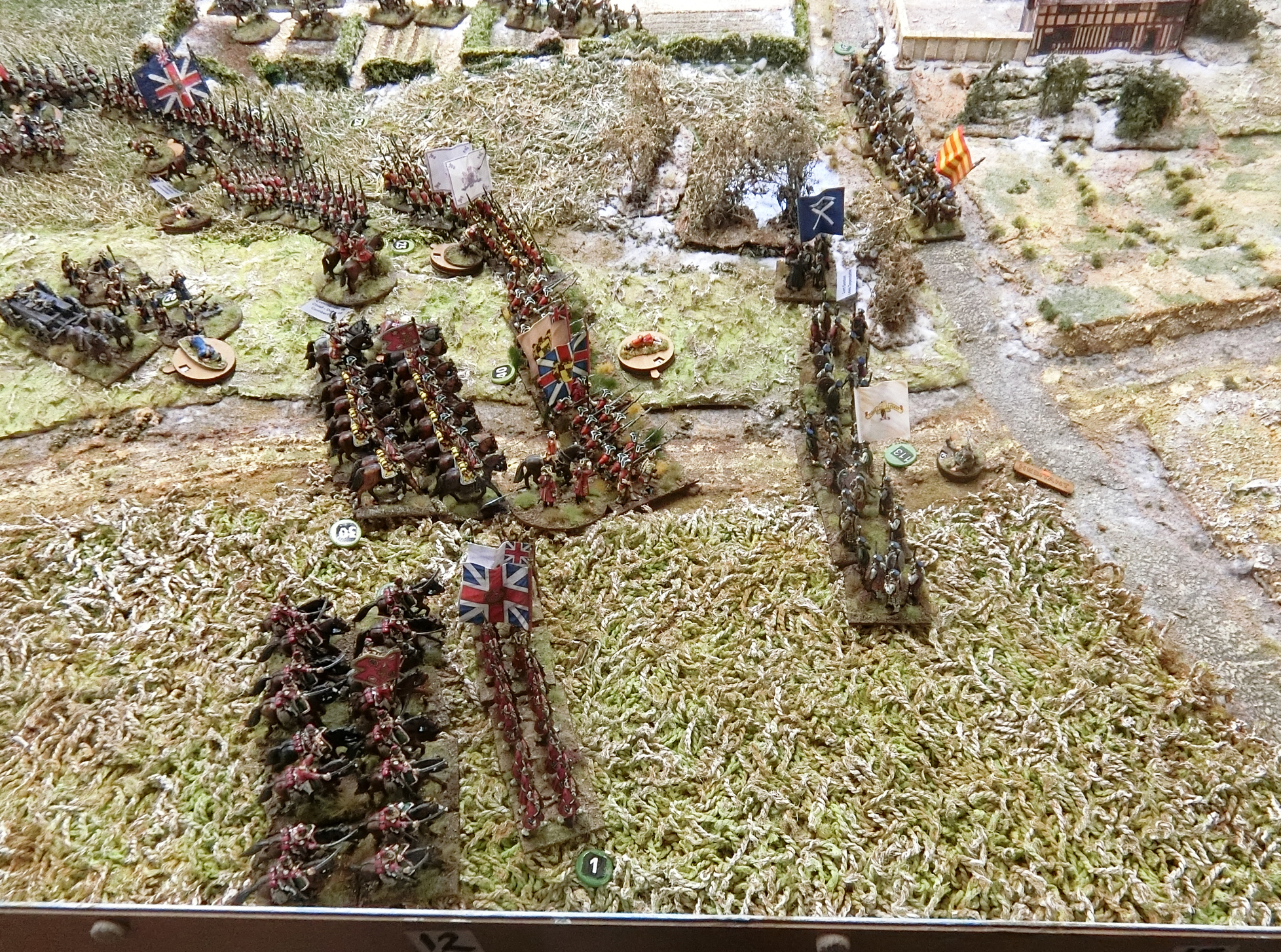
At the extreme right flank it actually felt a bit precarious for Cumberland. The exultant mix of Highland and Lowland clansmen were looking for opportunities to pick off weakened and isolated government units. The Scots 43rd Foot are in the foreground as the government right flank holders

On with the narrative by Guy:

Turn 6

<<We were then moving towards the climax of the battle. Despite winning the initiative, the French commander allowed the government forces to move first. This was unforeseen and led to much rather rude Gaelic mutterings from the flanks (by CG as assistant!). The government forces had received orders that their overriding mission was not to imperil the army or allow it to be defeated. Further, a message had arrived saying that the government reinforcements had sighted and were shadowing the French reinforcements and both sides were unlikely to see fresh troops.


The Government forces therefore started a modest withdrawal to strengthen and consolidate their lines. The shortened frontage only made the task of the Jacobites harder. Meanwhile, the Jacobites pressed on by attacking the mortar battery, but in a true Samson v. Goliath moment the plucky British gunners picked up their muskets and somehow survived to be able to withdraw and reform. 


There was further ongoing considerable attrition in the Franco/Jacobites ranks. In the West, inferior lowland units tangled with the 1st Foot Guards in the gardens and exchanged volleys, with the inevitable result. More French units were lost in the centre from ongoing artillery attrition.  The result was that gaps started to appear in the French lines which had to be plugged by reserve infantry and some small Scots and French cavalry units . 


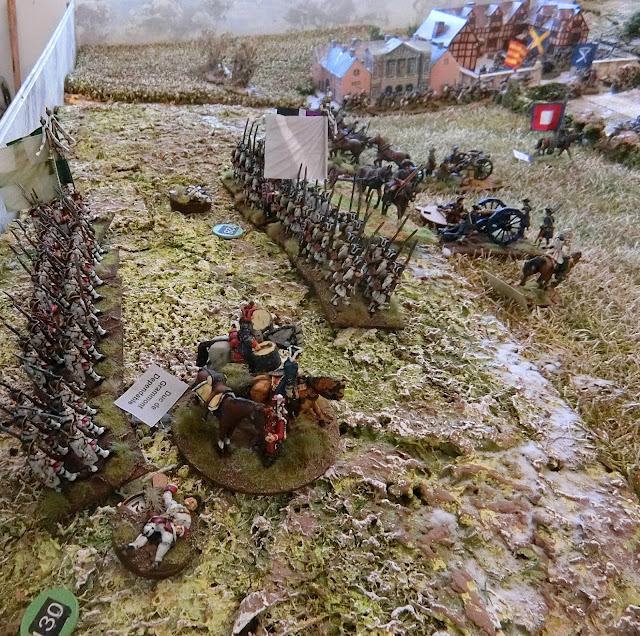
In the centre the Grenadiers de France break under canister fire from two light batteries

Steve's allowing his opponent the initiative meant Richard had the chance to bolster up that weak point  opposite the French cavalry......

......who would soon be taking casualties from long range artillery fire

At Harleston the one remaining government cavalry regiment heads towards the centre to find more fruitful cavalry ground 

Each government brigade had a battery of light guns. Combining with the threat of musketry volleys it meant that nowhere in the central area was safe for the French to attack


By the Hunting Lodge woods a German mercenary battalion was the next unit to break from long range attrition


On the government right flank, however,  the loss of units and the need to contract was causing a bit of confusion. Cumberland in person is organising the line and he has no units spare here to back up the Guards and Grenadier brigade which is suffering a Scots charge. The mortar battery has retreated safely with 4 Hits and is saluted by the nearby generals for blunting the Scots advance.

View from the French - it looks like their opponents are in a bit of a mess - if only they were nearer!
 Note the Lowland unit with yellow saltire flag is engaging a Guards battalion at the corner of Cumberland's line.......


.....but they were easily pushed back by the elite infantry

French casualties from an earlier hour are being recovered from under the influence of the French Commander in Chief

Reformed Highland clans on the Jacobite right now return to the scene of action. The villagers of 
 Harleston await the onslaught with trepidation 

This arial view shows the reforming government line very well.
Beyond Harleston church, fields and woods Richard has created an L-shaped
 killing ground in anticipation of multiple French and Scots mounted units trying
 to break his line there

Above and below: The rather sad state now of the whole French central line. All the brigades have suffered units lost and none feel strong enough to advance across that open ground into artillery and musket fire. A couple of double moves on Command Initiative dice would be good! Even so the French guns have forced back one of the redcoat battalions to their front.

Turns 7 -8


Artillery continued to fire along the lines with the government guns rather more effective than the inferior Jacobite ones. At the NW corner of the battlefield there was a last highland charge against the 43rd Foot (an inferior regiment here today and subsequently became the Black Watch). The 43rd were supported by 2 units which allowed them to send the highlanders back, although they also had to retire. A fresh British unit filled the line. 


A Highland clan attacks the good folk defending Harleston who held the hairy Scots at bay for one round of melee but went down on the second. This was still enough to put the Highlanders going back to reform on 4 Hits


On the other extreme flank a similar Jacobite charge went in against the loyal Scots 43rd Foot.....

.....however this wider view shows that a mixture of setbacks, reforming and close terrain had inhibited Steve's ability to get enough troops up the ridge quickly. That icy pond was a nuisance.

This clan under the Earl of Cromartie was broken, and so too was the 43rd. But the government line had plenty of reinforcements at this end

Richard doesn't look very happy, but in fact by late morning
on this Boxing Day the battle was turning in his favour

Slow but steady losses from the Jacobite guns was reducing units on the
government left so the line could  no longer reach beyond the church and
still retain that "killing ground" angle. Opposite, the French cavalry are
 hopeful of an opening

View from the French cavalry's position, where the front unit has already sustained 3 Hits.........

.....with de Saxe Lancers by their side and Baggot's Hussars and the Princes Lifeguard waiting to give support; meanwhile the Scots guns pound away wherever there is a gap

Near the centre the French are once again on the advance, trying to support the faster moving Scots

Le Duc de Grammont backs up the advance bringing forward his reformed battalions

Above and below: the advance from the Hunting Lodge of the Foreign Service brigade under the Marquis de Souvre  constantly met a wall of British fire. Now Lally's Irish regiment falls victim to it

The French Guard Brigade had not been able to make any progress, maybe now there was a gap for them?

Turns 9 - 10


In the rest of the line, the government commander continued to hold his position and the Franco/Jacobite force after a modest advance against the village of Harleston to eject some troublesome yokels armed mostly with scythes, came to the conclusion that victory was not going to be achieved that day. 


All, however, was not lost. The Jacobite army was still between Cumberland and London. The Jacobites had severely mauled the government cavalry which meant there was no pursuit. In the fading light the Franco/Jacobite army withdrew, and the 2 armies lost contact. 


Looking West up the battlefield from Harleston pond the observant viewer will see that one of the large French cavalry regiments has been forced to withdraw from artillery fire losses. The Jacobite and other cavalry are all small and/or inferior so I think we all knew now that Prince Charlie's efforts on this flank were doomed


On the Althorp Manor flank the Jacobite thrust up the ridge was looking distinctly lacking too


The Chisholms had lost a Hit when Cromartie's ran through them giving them 3 Hits and therefore a Minus on everything till they could recover. I denote three Hits with an orange marker for quick reference


Cumberland has managed to steady his line, but it's still scrappy and nearly all these battalions have suffered hits. It's now about 1 pm and several have been in action since 8 am


Aftermath

The government forces were left in possession of the field which allowed Cumberland to claim a victory but………..


It was certainly not a crushing defeat of the rebels as demanded by the King. Large quantities of ammunition had been expended and supplies were running low. The Jacobites were now between them and London, their principal point of supply. 


The result was also not particularly satisfying for the Prince. Whilst the combined Franco/Jacobite army had fought well, and at one stage certainly seemed to have the government forces on the ropes, it was perhaps illusory. The government battle lines had never really been challenged and a number of fine French infantry regiments had been destroyed. For the first time in the campaign his troops had not achieved an overwhelming victory. The British/Hanoverian government troops from the continent were certainly a far tougher nut to crack than the troops he faced at Prestonpans and Brampton. The Prince could only claim that they had given Cumberland a bloody nose and the army had withdrawn intact to fight another day. 


However, he has nagging doubts whether the French are trusted allies and will continue to support him? Whilst the route to London is effectively open, if a council of war proposes a retreat to Scotland, this may now be problematic from a purely geographical perspective. Retreat northwards may not be an option.  


One way or another, the campaign continues. The rebels are still loose in central England and the throne is still threatened. 


Above and below: Guy conducts "post match" interviews with the team captains (not the Managers, Royalty is above that):
Duke Ferdinand of Brunswick : <<Vell, I did not catch zee stag for zee Weinachten Jagd but zee high point für mich zis day woz to see zee Grenadiers de France fall beneath mein guns, and to be part of zee masterful control of zee game battle by My Lord zee Duke of Cumberland. It woz, as you sagen in English, "a team effort">>
Lord George Murray: Eh well, the lads surely gave those Sassenach Dragoons a seein' to, jus' like we did tae Johnny Cope. Can't trus' the Frogs o'course, they did naught a' day, what dae ye expec'? As fer that bloody assistant referee runnin' up an' doun oor touchline, he was f***** useless (pardon mae French!). An wen yon mortar crews started tae fire back wi' muskets!!? Och Aye, we shudda bin given' a penartie, nae question aboot it! As fer my high point? Why, that barrel o' 1720 malt whisky "rescued" from yon Earl Spencer's cellar!>>

Man (Unit) of the Match - the British mortar crews for saving the penalty that their demise would have represented on the flank of Cumberland's line.


Postscript


Ferdinand of Brunswick once again received glowing compliments from the King and the army for his steadfastness. 


The Hon John Spencer crawled out of his priest’s hole to survey the devastation of his house. He took the decision that day to rebuild Althorp. The stable boys and villagers called him Hon Cringeling behind his back. He became aware of these derogatory comments and the villagers Christmas boxes were cancelled in 1746. For decades the stories of the stable boys and villagers’ valour multiplied in the local public houses to the extent that in the local folklore, the battle was solely between the hearty sons of Northamptonshire and Scots. 


The British cavalry were again the subject of much criticism. A duel was fought after a Guards subaltern referred to them as donkey wallopers. The name stuck.


The Jacobite troops in the main were further emboldened by their performance and the success of the highland charge. They failed to appreciate one of the lessons of the battle, i.e. the Franco/Jacobite units had great difficulty advancing and breaking a formed British infantry line supported by artillery. They continued to maintain the effectiveness of the highland charge as a battle winning tactic. 


Post battle - the campaign goes on


The Franco/Jacobite forces manoeuvred to join with their covering forces at St Neots and a Council of War was called to decide which direction the army should move. Various options were proposed – a fast advance and attack on London, an indirect advance through East Anglia which would have the advantage of resupply by the French ships, a withdrawal to Scotland, or a march towards Oxford and the Southwest. 


The Government forces dispatched their remaining cavalry to discover where the Jacobites had gone. No conclusive news was forthcoming. Cumberland therefore ordered a forced march towards London. Perhaps the truest indication of what happened was seen in the City of London. The value of Government securities lurched downwards, and gold was in huge demand. Hysteria gripped the streets as rumoured sightings of hairy Scotsmen on Hampstead Heath circulated. The ladies of fashion dusted off their Parisian decolletage gowns and the gentlemen their bottles of Sauternes...........  


The game record shows that the Jacobites won the initiative every turn (Plus 1 as designated attacker) Although the game was not just about army destruction this is a useful indicator (using my 1-5 Army Points per unit system) - In terms only of units on the table "Done For" the Jacobite/French 37 points represents about 30% losses, and the Government 23 is in fact about 20% losses. So bad enough for each commander to be glad of the natural break in fighting allowing a withdrawal

(by CG) Finally, I need to pay tribute to Guy. He deserves great credit for putting together such a complicated scenario, providing most of the ideas and 95% of the figures which made it to the tabletop, compiling the briefs and orbats (under guidance from me), and being lead umpire for two days.   Thanks a lot Guy, wonder what next year will bring?


Friday, 13 May 2022

The Battle of Madling 1753: Part One - Introduction and making the battlefield


Background

In the previous post I outlined three weekend games we have planned here at my humble Cotswold retreat. The first one was to be Wiltshire's Ken Marshall organising the next episode of his Imagi-nations campaign between the mid-German forces of "The Electorate" (a bit like Prussians and Hessians) against the equally formidable "Ducal" armies (white coated Austrian types with Hanoverian style allies), and we had now advanced to October 1753.  I decided we would use the standard 8 foot x 6 foot table and my contribution would be custom sculpting whatever terrain Ken wanted.  The date for the game was set for 23-24th April and we ended up with 3 other players and me, with Ken as umpire, on the Saturday to play out a fight for territory between the two substantial Advance Guards. The Sunday brought two new players and the main armies to try to decide the issue. 

I was amazed how Ken's collection of Minden/Crann Tara/Fife and Drum 28mm figures had grown - to about 1600-1800 figures I think. In addition we called on a few hundred of mine and about 400 - 500 from Paul B of Cheltenham.  I was worried this would be too many for the table but Ken felt confident a lot would be overcome by attrition on the first day, nevertheless he had to ensure some substantial forces for the newcomers to command on Day Two. As those two were "Honours of War" creator Keith Flint and his play tester Steve Johnson, we wanted to put on a good display.  So you will have to forgive the toy soldier megalomania which made manoeuvring room at a premium but wargames eye candy at the maximum. I hope you agree - here is a glimpse of what is to come:

Paul and Keith are having a serious advance with the Ducal army while Steve J tries to distract us all with his good natured banter

Yes it got a bit crowded but "Honours of War" can stand that. Retreating or fleeing through masses like this can take its toll.

No shortage of cavalry action in the centre and far flank

Anyway, much more of that later, this post is mainly about making the battlefield and a basic intro to the game.

Dismantling the previous sculptured table top

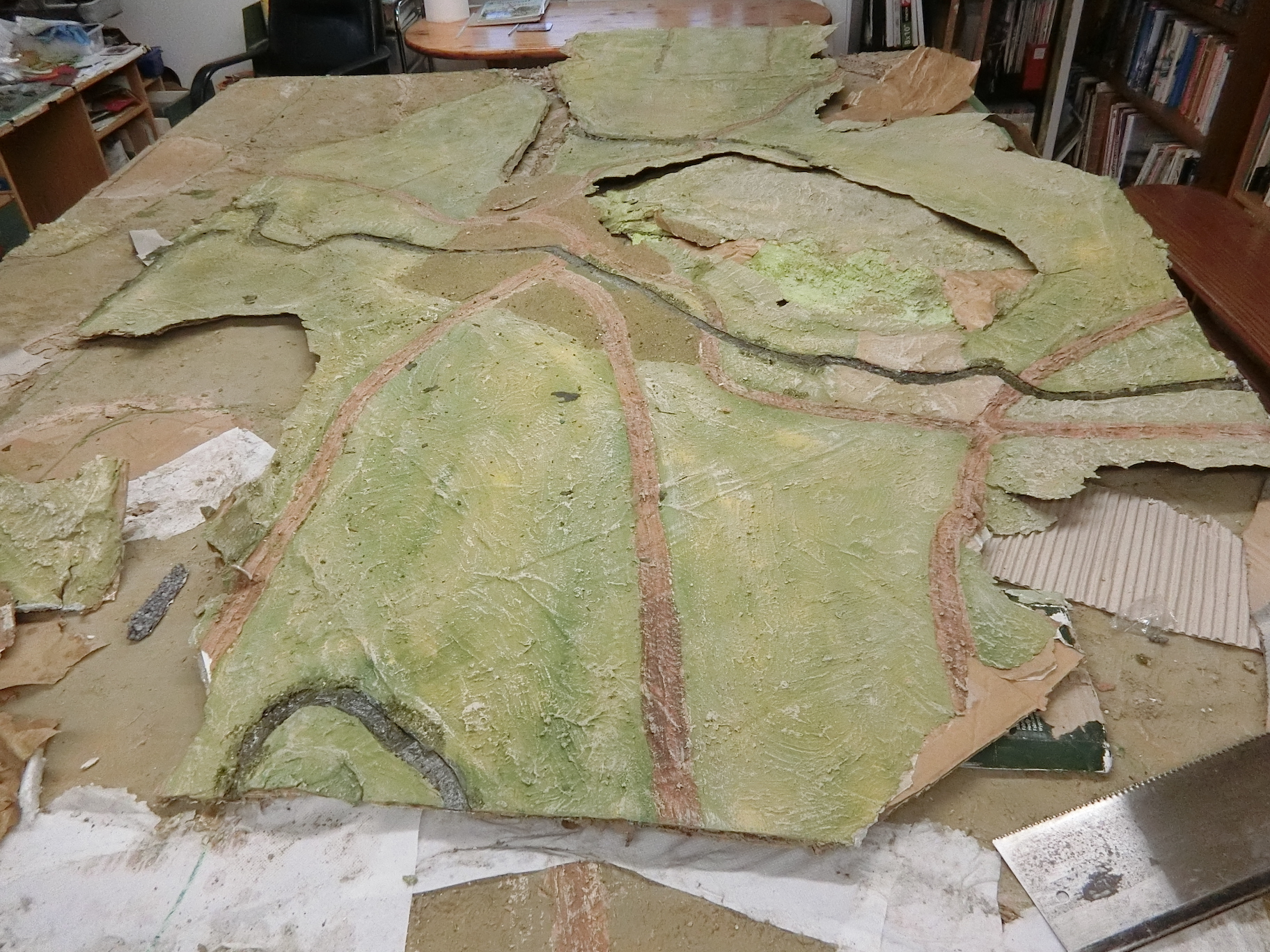
For those who have lamented the demise of my previous "art installation" terrains, don't worry, not much goes to the local tip, most of it is recovered and reused in different guises. I will start off with some photos of dismantling the previous Langensalza terrain in January.

Releasing the cardboard base from its bed on top of the
old Brampton board
Recovering hills and useful textured surfaces for storage and
future re-use or adaptation

Creating the battlefield for the Battle of Madling

Here is a look at Ken's sketch map which he sent me as a starting point, together with a description of the kind of terrain he envisaged


And this is the version I made of it in Adobe Photoshop to use as my scale guide for the build. (I don't have the full pro version but I find Photoshop Elements 2020 is adequate for my needs and affordable to buy). 
It looks like I must have decided unilaterally that the corner high ground in A-B8 was to be steep!

I will describe the stages in making the table from start to finish by photo captions. Most of the methods will be familiar to my regular readers and apologies if I bore you. However, towards  the final stages I did things a bit  differently. 

I used large surplus cardboard packaging to give a fairly flat surface.
Joins were sealed with masking tape covered with PVA

Reclaimed hills were used where they were the right size.
 Elsewhere flat pieces of textured surface  were stacked to make a
 roughly stepped hill or two which will be smoothed out a bit later.

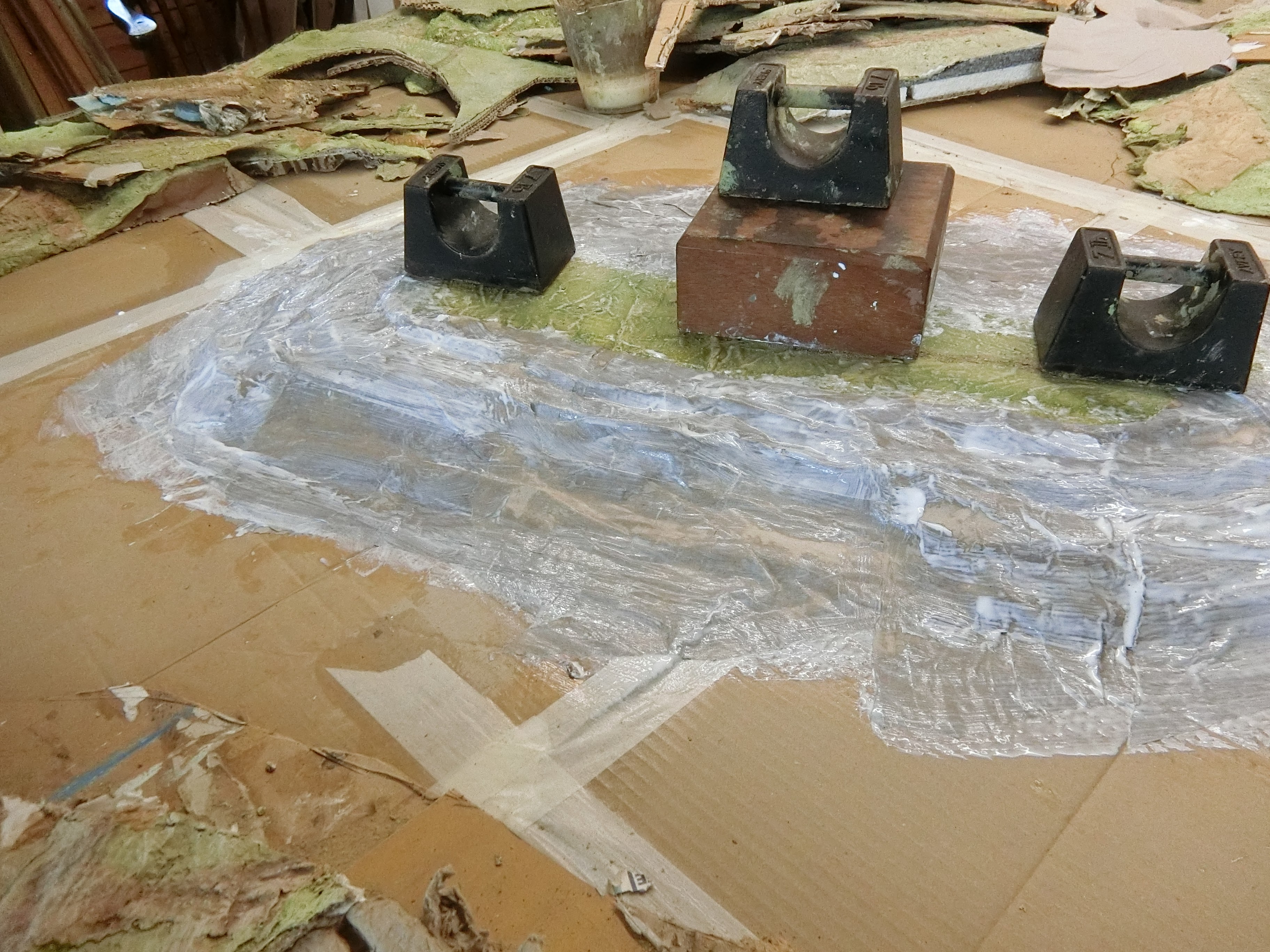
Smoothing out first stage with papier mâché and PVA

Weighted down to prevent warping while it dries out

More hills cobbled together from pre-loved pieces and masking tape
before the papier mâché coating (below)


Here is the high double contour corner piece in process

Checking my construction map I realised i had made the Rosenkranzhohe
too big!! I had to get the saw and make a drastic change.

Now the hills were in place I sketched in the roads and rivers with marker pen and thin acrylic wash


If it is thick enough (about 3-4 sheets of paper) the papier mâché and PVA dries to a satisfying hard surface

Time to use a heavy, sharp knife to cut out the streams and river
 to make use of the natural recess depth of the cardboard packaging

Then blend in the stream banks with more papier mâché

Treatments begin to get more optional now. This time I have used a thin mixture of builders plaster to coat the stream and river beds as an undercoat for colour

While that is drying I can get on with a big job...

.....coating everything except roads, rivers and BUA areas with various green textured gunge.
This time I just used builders plaster, sand, acrylic or commercial matt emulsion paint, and water.
No sawdust, small stones or PVA glue. Omitting the latter was a mistake.

It looks quite nice though, and does help to blend in those stepped slopes

Not really deliberate but the greens turned out differently due to different mixtures and running out of some shades part way through. As an artist I tend to play it by ear and use what I have, adapting as I go along.....let's see how it dries out

Applying a dark mixture of paint and PVA to the stream beds

Brown plaster and sand mix helps define a cliff line and paths on the very steep hill.
A similar mix is used for a base coat for all the roads

River beds and roads all blocked in now with base coat mixture - textured for the roads, smooth for the water. A simple brown and/or sand/PVA coating for the built up areas (BUAs)

When it was all dry and hard I went over the entire surface
with my surform tool and ground away at the little nibs of hard sand or plaster.
The idea is to keep texture but not so much that it is ugly or difficult to put troops on.

The residue can be swept up and stored to be used for something else

A thin wash of dark brown acrylic paint fills the ruts made in the plaster roads

I used a dull brown runny mixture of paint and PVA
on top of the dark river beds. There are no right or wrong ways here BUT,
rivers are only blue when you are so low down on the bank as to see the reflection of sky.
If you are flying low in a plane, helicopter or air balloon have a good look down on the rivers

While it was still wet I introduced more dark paint nearer
 the centre to represent a deeper depth of water  

I like to work across the whole area with different effects to keep it in all in mind like a landscape painting. So now I have done some lighter dry brushing to bring out the high ground better

But then I extended that treatment to the low areas too, and to the casual eye it all looks similar. Some might be happy to leave it there.

Keeping at the dry brushing with slightly different combinations of colours. Over the days I noticed that these greens take on quite a different hue if photographed in daylight or under the strip lights we  normally use during a game.

I used a nice warm cream as a dry brush for the road network.
You can also discern the slightly varied dirty water colours

No PVA in the gunge....the plaster drying out had caused
some cracks where my cardboard joins were.
I used sawdust and artificial grass mixtures to try to disguise it

That led me on to something I've not done before - the wholesale spreading of static grass and sawdust combinations over all the low ground areas. My idea was to make it look like well watered productive pasture land, and leaving the high ground bare to look a bit more like moorland heath. 

Quite pleased with this result. These two views of the same with different lighting

I used dried or burnt grass flock for the very highest contours in each corner. Lots of areas of the world have brown grass where the soil is thin and well drained such as rocky moorland or plateaux.

The roads have yet another lighter drybrush and I'm putting some terrain features on now.
The redoubt has to be very old (Thirty Years War) falling apart and overgrown by weeds.

I pre-made the bulk from air hardening clay and stuck some coffee stirrer bits in it.
I stuck that in place on the hill then more wooden stakes and a mix of sand and flock effects.

Looking round the finished battlefield

The above sequence is effectively the end of the "how-to" part as I seem to have got carried away with finishing the detail and adding the woods and buildings and have not taken any specific build photos. So what follows is a look at certain parts that might be of interest and then the overall effect.

First the finished redoubt. All the loose stuff was brushed off then dry brushed with cream acrylic. Adding tufts for weeds completes the tumble down look

Two views of the Village of Madling. All the card buildings are reinforced with balsa wood and are removable for putting troops in the BUA, but hopefully have a lived-in sort of look. I did not get round to weathering the card models before our game but I have since!


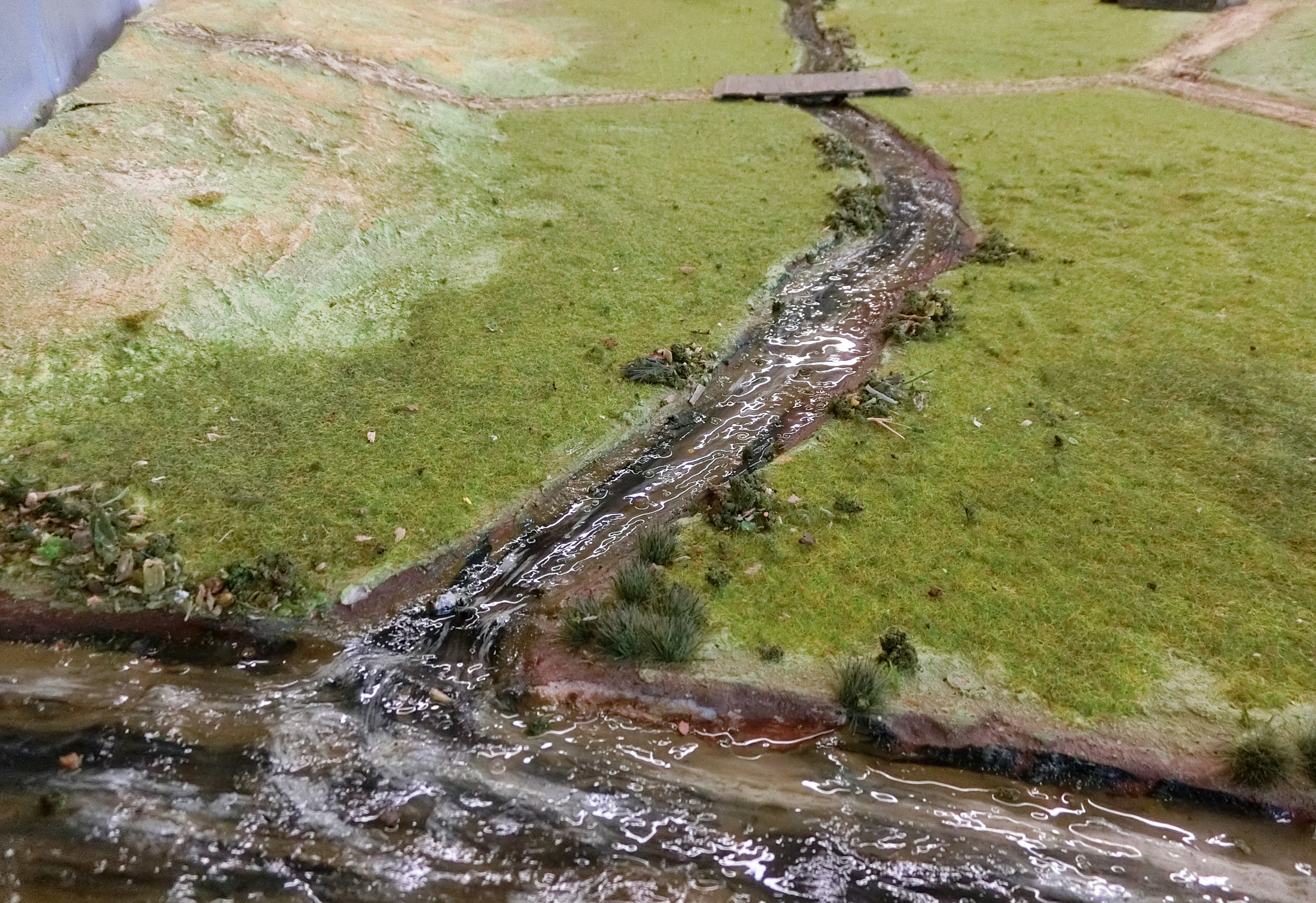
Close up of the Stronbach river and Lunzenbach stream. The previous paint was finished off with light dry brush of white and when dry was coated with up to 5 layers of acrylic gloss varnish. 

View showing the transitions of surface textures from the basic painted terrain through static grass/sawdust finishes, and all the streams were judiciously edged with my general mixture of green foam scatter and commercially bought tufts. They help offset the stark look of the cut-out cardboard river banks

Kaindorf in the foreground

The hamlet of Mauthaus


Looking down on Lunzen from the high corner moorland with cliff edge and paths. Covered with dry grass in two or three colour combinations and "winter tufts" to mark the paths.

Finished effect before the soldiers arrive

Battlefield as parade ground

I wanted to give the players an idea of how big the units are before the day to help their planning. So the following is a further look round in the company of my small, but growing, Hanoverian army.


The overall look with an "Honours of War" brigade of infantry and one of cavalry, and an independent battalion of Jägers garrisons a forward hamlet. By now I have refurbished the grey cloud/smoke backdrop which sets off the terrain nicely and is multi-use. The how-to on Making trees I did a year ago.

I will finish off by giving you a taste of Ken's Imagi-nation campaign. We pick up after the battle of Stadl an der Mur

The Mur Valley Campaign Madling, October 1753. Electoral Outline

"1753 The Elector has tired of the long period of peace between the electorate and the Grand Duchy. Whilst it has been useful in allowing him time to rebuild and train his army, the time has come to further his territorial ambitions by seizing the Mur valley from the Duke.

The annexation wasn’t as easy as the Elector expected. The Ducal army reacted swiftly to the invasion and successfully halted the electoral advance before Tamsweg. The campaign has degenerated into a war of outposts as the two armies struggle to gain an advantage and the fear of failure overcomes any martial ambition or initiative by the two commanding generals.

An attempt last month to outflank the Ducal forces at Stadl failed and the appearance of unidentified foreign regiments at that battle confirmed intelligence that the Duke was being supported by a coalition of neighbouring states who have also suffered from the Elector’s military ambitions. Although coalition forces have not been committed to the fight anywhere else, it can only be a matter of time and the army is likely to find itself heavily outnumbered.

The Elector’s generals now await the arrival of winter and an end to the campaigning season that will allow them to consolidate on their gains in preparation for a resumption of the campaign next year.

The message from the Elector is clear. There can be no more failure after the Stadl debacle. The army will not give ground and lose the territorial gains made. Several of the generals whose performance particularly displeased him at Stadl are now residing in the Electoral prison at Oldenburg and he has made it known that there is plenty of room for more to join them. "

In outline  - The Electoral Commander, von Stuttenheim is defending everything to the East of the Stronbach. He only has two brigades of mixed light troops at the start and the Ducal Advance Guard is expected to arrive from the Northern baseline...............

Steve and Kevin conceal most of their defending troops ......not much to see

......until Paul's Ducal Hussars and Grenzers hit Lunzen farm like lightning and the defenders are revealed.


A lot more next time.......

(PS Please feel free to comment but my replies might be delayed due to a pressing commitment away from the computer)