Showing posts with label Abensberg. Show all posts

Saturday, 15 November 2025

1809 Project in 15/18mm: Battle of Eckmuhl Part One - Historical and Wargame Background

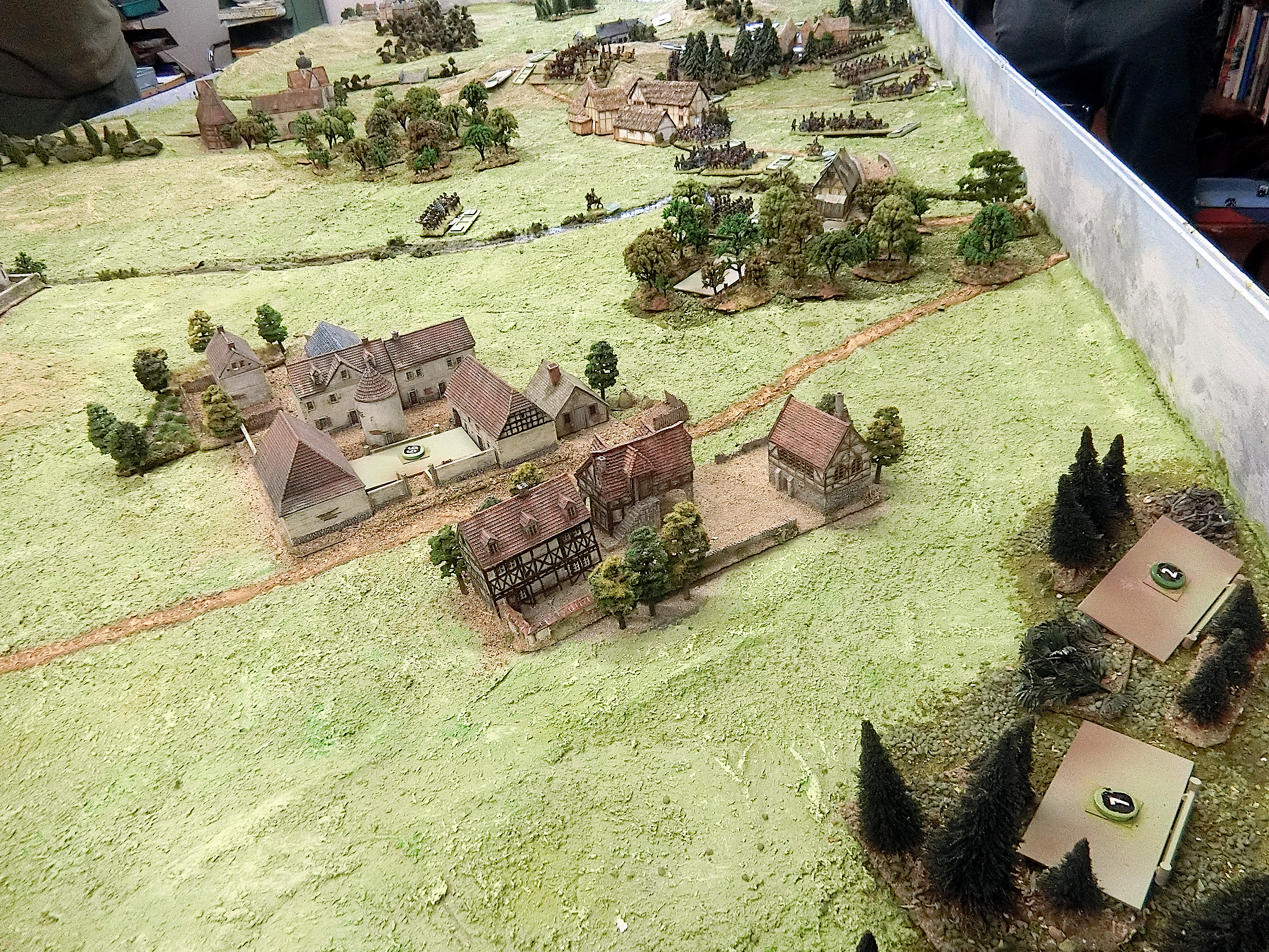
 As outlined in a brief post about a month ago we staged a three day wargame refight of the Battle of Eckmuhl in mid September at my den in the UK Cotswolds and I'm now getting round to reporting on it properly. This post covers the historical and wargame background, and next time, how I went about making the terrain. 

CG with two of the 1809 core team - Paul B and Steve Johnson, seen near the start of our Eckmuhl refight

Wargame Background

Regular readers will know that my resurgence of interest in 1809 started about 3 years ago when I got a touch of collecting megalomania and bought a lot of ready painted miniatures from Ebay in earnest so that I could start testing rules and get cracking before I get too old. I took Keith Flint's excellent 18th Century Honours of War system and spiced it up a little, better to reflect the greater flexibility in Napoleonic organisation and tactics and leadership qualities. We did a big test game once per year - fictitious in 2022; Hausen-Teugen-Dünzling in 2023; Abensberg in 2024, and by the latter we'd arrived at a fairly settled set of rules - just as well really as I had already called them "Abensberg to Wagram" (A2W).  Having used them successfully for Eckmuhl I've got the confidence now to post them for readers to see, and use if they care to, in my Napoleonic Download section in the right hand sidebar or here.

(Please note they are not a completely self contained set of rules as I expect anyone seriously interested in trying them will be familiar with the basics of Honours of War, or be willing to buy the Osprey rule book. There are ideas in there though worthy of a look whatever rules you like.)

Serious thinking about Eckmuhl started in early Spring this year but I had not found time to blog about wrapping up Abensberg (October 24) so in brief here goes:

Finishing off Abensberg

Historically Abensberg was a sprawling battle which ended in something of a rout for the Austrians due to a major flank attack on Hiller's army by Lannes' makeshift, but excellent Corps. Fighting in the southern half of the battlefield did not get going till afternoon and then just became a running fight. In our refight Paul B, Martin Gane and Steve Johnson put up a good resistance and made enough time for Archduke Louis to rally much of his Corps and unite with the Reserve Grenadiers to defend a portion of the southern battlefield, while Lannes chased off Hiller's own troops towards Landshut. I was keen to see what could happen in the South and two old friends who had been unable to attend the main weekend, Graham Ward  and Richard Newcombe, were keen to help me in October 2024. We used just the 8 x 6 table  and Richard had Marshal Bessieres commanding a small corps made up of  the Wurttemburg contingent of VIII Corps and Deroy's 3rd Bavarian Division plus a brigade of French Cuirassiers later on. Under fairly sluggish commanders I gave Graham a good sized force of rallied and retreated Light and Line troops from Archduke Louis's Corps and the Grenadier contingent  from II Reserve Corps with artillery and cavalry too. Graham opted not to defend the whole area but kept some dummy markers cleverly concealed in his right flank woods and villages in an effort to gain time. Time proved not to be on Richard's side as he had a sequence of poor command Initiative rolls for the Wurttemburgers , causing them to fail to make ground and steadily suffer from Austrian artillery and skirmisher fire. By the time Deroy's Bavarians had pounded with artillery and closed in Graham still had a consolidated line defending a stream and an open means of retreat.

But for the imbalanced command rolls it would have been a very tight game and I'd recommend this kind of scenario to you to try out - all my briefing documents and orbats are here

If you can't get enough photos of Napoleonic miniatures then here is a link to the full set of my Abensberg late afternoon game 

For the casual reader here is a brief taste in pictures

Red lines mark the 8 x 6 area of the original table used for this game. Blue and red dotted lines for the deployment limitations of Allies and Austrians respectively


By about Move 3 Richard had cleared off Graham's dummies and advanced through Kirchdorf.....

........but poor command rolls meant his Wurttemburgers never progressed beyond this position on the right flank

Graham is consolidating in an L shape at the far corner of the table. In the centre Wurttemburg Light Infantry and Bavarians are trying to breach the Austrian line

But Graham has amassed a formidable array of cannon on the high ground and he has a regiment of Lancers just off table  to the left of what we see here.

In the foregound Bavarian cavalry retire having been seen off by the aforementioned Lancers. Bavarian infantry cross the Perkabach but to their right the hard fighting Wurttemburg Jagers retreat to reform.

Overall both sides had fought each other to a standstill but the Allied victory conditions required a more impressive "victory" and Graham had achieved the standoff he required for the Austrian left flank of Hiller's army to retreat in good order and not the historical rout. Thanks to both these stalwart wargaming veterans for giving me the chance to work out this part of our "what if" 1809.

My mind was now clear to think ahead to Eckmuhl.

Historical Background to Eckmuhl
As you will have gathered from the above my approach (and my mates seem to approve) to "refighting"a campaign is to minimise the admin by taking each battle on its own historical merits and then applying logical "what-if" elements to try to make a balanced game, while keeping true to the historical terrain, forces and commanders. So for Abensberg the Austrians put up a much sterner resistance than historically and ended up retreating through Allied pressure, rather than being routed wholesale. It was thus with a clear conscience I could proceed with Eckmuhl on the same historical basis.

The main sources of reference I found useful were not surprising:

Thunder on the Danube, Volume I   by John Gill. A thorough, detailed  historical account with good maps and orbats.

Eagles over Bavaria 1809 by Michael Hopper. Brilliant breakdown into manageable wargame scenarios, roughly at my 1:40-50 scale, so particularly helpful and I pulled on it enthusiastically for my version.

Eggmühl 1809 by Ian Castle, Osprey campaigns series Nr 56. A really nice book on the whole Bavarian campaign with useful maps and illustrations including some modern day photos of the terrain

Echmuhl 21-23 April 1809 - Great Battles of History Refought by P.P.H. Heath . I was only referred to this after I'd done the work but it's an interesting breakdown of the detail for wargame purposes 

and for nostalgia's sake:

Napoleon and the Archduke Charles, by F. Loraine Petre 1909 but mine is the 1976 reprint (Charles Grant's old copy in fact!). Not so detailed but back in the day when I first got into this (mid1970s to early 1980s) it was about all there was apart from Chandler's Campaigns of Napoleon

I like to ask what it was that each commander was trying to achieve in  the big picture. In Napoleon's case, on 21-22nd April, to unite his army for a crushing blow which would push the northern Austrian army across the Danube, out of Bavaria, and into Bohemia, so he could once again destroy Austria's military power.  For Archduke Charles, ironically, it became the same in reverse. By 22nd April he had gained Regensburg and the Danube crossing so wanted to unite his army from the northern bank to the southern and create an offensive against the Allies to  curb any further Allied attempts to thwart his invasion of Bavaria. Neither commander actually knew the true position of his opponent, but Napoleon got his act together first with fast moving troops while Charles was having one of his many "off days" it seems, making over-complicated instructions not really rooted in reality.

Archduke Charles watches the
 Allied approach from above Rogging
 (AB Miniatures by Paul B)
Napoleon and Lannes supervise
the Wurttemburgers' assault on Eckmuhl
(AB Miniatures by CG)


Here is the map I worked up on one of Gill's to give to the players to explain the strategic situation.
Marshal Davout with about half his infantry and most of his cavalry from III Corps had been watching , and skirmishing with, the Austrians from Abbach to Schierling since the battle of Hausen-Teugn on 19 April.  By 21 April he was being backed up by Bavarians under Lefebvre  who had come from the Abensberg battle.   He was convinced that he faced the main Austrian army  to his East, around Eckmuhl, but Napoleon didn't believe it. On that 21 April  Napoleon, Lannes, Bessieres and Vandamme  had pursued the routing troops of Hiller's wing all the way from the Abensberg battlefield to Landshut. The Austrians lost huge amounts of ordnance and baggage en route until they were finally able to reform on the South bank of the Isar at Landshut and begin an organised retreat Southeast. Only then did it click with Napoleon that this was not the main Austrian Army and that Archduke Charles was in fact much further North. 

During the evening of 21 April - with order changes throughout the night into 22 April, a rather mixed up Charles created a plan to take back control. His northern force consisted of the rather disheartened and weakened Corps of Hohenzollern and Rosenberg (III and IV Corps) and the I Reserve Corps of Cuirassiers and Grenadiers. Since the bridge over the Danube at Regensburg was now gained his II Corps was ordered to cross and, with the others, form five "columns" to drive a wedge through some fantasy Allied force between Abbach and Alteglofsheim. To do this he totally wrecked the Corps structures of III, IV and I Reserve and effectively emasculated whatever leadership cohesion there had been hitherto (not much!). In practice the constant reorganisation, new instructions and confusion left  too large an area to defend south of Schierling and Eckmuhl and the defensible area contracted as the realisation gradually dawned that he'd been outwitted and outmanoeuvred. 

In the early hours of 22 April Napoleon had split his southern force, with Bessieres to watch Hiller's retreat, and all the rest, including Massena and the entire Heavy Cavalry Corps, marching at full speed due North from Landshut. This is one of those forced marches for which the early Napoleonic Imperial period is famous and so, while Davout and Lefebvre watched patiently from the hills above Schierling, thus pinning their opposition to the Eckmuhl high ground, Napoleon, by early afternoon, brought  the equivalent of a good sized infantry Corps and a Cavalry Corps into play, with more to back them up. Charles' immediate force was completely outnumbered and ironically, in ignorance he had withdrawn strong forces of Grenadiers and Cuirassiers which could have made a big difference.

Two French Cuirassier Brigades. Various manufacturers from collections of CG and James Fergusson. Artillery - AB Miniatures by Paul B. (Photo credit - Stuart C.)

Austrian infantry - AB Miniatures by Paul B. (Photo credit - Stuart C.)

Making Eckmuhl a "fair" wargame refight

Maybe I've been a bit tough on Archduke Charles in the above, but seriously, even the most hardened Austrophiles (and there are two in my group) need a bit of TLC and a helping hand to make this a balanced wargame. I started by metaphorically throwing all the cards up in the air to see how they landed. By that I mean Charles had destroyed his own Corps structure and command chains so I looked at all the various Brigade and Division sized units which could have been in striking distance of my battle area (the green rectangle on the map above)  - there proved to 15 of them. Then gave Charles his three Senior Commanders - Hohenzollern, Rosenberg and Liechstenstein and he could allocate 13 of the 15 among them as he wished. The Austrian deployment area was large and I divided it up into layered Zones 1 to 5, with theoretically a senior commander in each of 2 - 5. The units only had hold/defend the local area type orders, until messengers were received from Charles. In extreme cases that might take 6 Moves.  Here is the map I gave the Austrians to help Paul B decide on his deployment .

This is the overall map. Big rectangle is the usable "battle area", the inner rectangle 12 squares x 8, is the actual tabletop. Austrian zones in red and the indication of Allied deployment in blue dotted lines. Much more on this map in the next post

The remaining two units were Vecsey's flanking force in Zone 1B and Vukassovich's light troops in and around Eckmuhl (Zone 1A). Paul was also plentifully provided with dummy blinds too so could choose where to give a stronger impression than he had troops for.

This is the map I gave to Richard Newcombe and Tony Dillon as Napoleon and Davout for the Allies.


This was a lot nearer the historical dispositions per Corps/Division than for the Austrians since I felt it would work to develop the advance with the three days we had, and the amount of players. Zone A is an "imaginary" Montbrun as the French flank guard force of light cavalry and infantry - he was not on my official orbat as I did not really want a massed French cavalry outflanking move so far off the table area. Zone B is Davout's III Corps and also under Tony's command at the start Lefebvre's Bavarians and Demont's French in Zones C, D, and E. St Germain's Cuirassier brigade was also at the forefront of this force in Zone C.
South of the Grosse Laaber river Zone F was for Vandamme's Wurttemburg Light infantry and cavalry with horse artillery who will be expected to engage Eckmuhl schloss and village at the outset of our game. In Zone G are the main mass of the French Heavy Cavalry (14 regiments in total for our whole refight across the southern part of the battlefield). These are nominally under Lannes' command but Napoleon is also near at hand. The A2W rules make allowance for a combination of exceptional commanders acting in cohesion to get things going quickly. Zones H and K are for Lannes' two French Infantry Divisions. That Zone J off the map represents the approach route for more cavalry and infantry under Massena later on.

General Vukassovich defends Eckmuhl bridge and schloss with Grenzers, light cavalry and artillery, while the Wurttemburger Light infantry are poised to attack from Unter Deggenbach

To their left, along the Grosse Laber, Austrians prepare to defend Rogging and Pfakofen against the approaching columns of Lannes' infantry 

The game was to start at 1.40pm on 22nd April and if we could got through 18 Moves at 20 minutes per Move it could take us up to the start of dusk around 7.30-8pm. The whole available Austrian army amounted to 67,000 men represented by around 1500 figures . The Allied force which I would allow to arrive in time totalled 89,000 men represented by just short of 2000 figures.

I think that is enough for now and next time I will explain about the design of the battlefield and how I constructed it.
For those who want the full briefs and orbats the resources I made for this refight can be found here , or under Eckmuhl in the 1809 Campaign folder in the Napoleonic Downloads at right. 

The initial deployment of those troops which are visible. Green plastic "blinds" conceal those which are not revealed yet, or are dummies.


Tuesday, 1 October 2024

1809 15/18mm Project: The Battle of Abensberg - Part Two, 1030am - 1pm


Thanks for all the great comments on Abensberg Part One and for your patience waiting for me to start the After Action Report proper.  Please have a look at Part One for historical campaign background, the strategic area map, game design ethos and making the terrain. This post will cover the immediate background to commencement, and the Day One action from our weekend which took us over the first two and a half hours of historical battle time.

A setback before we started

As I usually do,  the invitations went out months before the game and I eventually ended up with three Austrian players and two Allies on the Saturday (2 were just for the one day) and then a "fullhouse" of 3 players aside for Sunday when more troops and players would be available. But a week before the game Phil had to let me know of sad family circumstances which precluded him from taking part. I had no reserves and a couple who I tried again were not available, so I asked James if he would mind swapping sides and he very quickly agreed. He had a few days to absorb the French/Allied brief but Richard was still going ahead as Napoleon, doing all the map work and deployment plan - phew!

View of opening dispositions from behind the Austrian lines. The hilly and wooded terrain meant both sides retained their "blinds" for a few moves, not all were real units.

I received the Austrian deployment map from Paul B and Martin Gane in good time and made a few small Game Masterly alterations due to misunderstanding.  Richard had worked hard since returning from his holidays and I received the Allied deployment map and a detailed unit run-down by map square too by Thursday.

Paul and Martin start with a very positive attitude!

But then, the day before the game, Richard had to cancel as he had got COVID (Curses - it's still around!).  That left me and James to try to figure out not just the Allied on-table deployment but all the off-field strategic stuff too that was going to have a big bearing on the action.

So some of the command "atmosphere" I put in the briefs had to be simplified, with James commanding the Bavarians (in practise just 1st and 2nd Divs on this day) and me as a rather passive Napoleon (so as not to sway the course of the game too much) trying to mastermind all the rest. To reflect the different Corps structure I commanded Hugel's Wurttemburg Light troops.

And in Move One, at least, James is still smiling

Deployments and Objectives

Here is the Austrian deployment map (slightly modified by me to reflect the cosmetic misunderstandings referred to above). A more detailed understanding can be gleaned from both sides' briefs, orbats and deployment instructions in the Abensberg Download files here.

Austrian deployment: Thierry's brigade is isolated between Offenstetten and Bachl. 
Archduke Louis' Corps defends the width of the table in rows 4 to 8, majoring the defence on Perka, The Horlbachs and surrounding woods and high ground. Hiller has two Divisions available off table around Mandelkirchen but I've restricted their appearance until battle is joined with Thierry. Also available well off table  (near Pfaffenhausen) is the small Reserve Corps.

As mentioned in Part One Hiller's perception of Allied intentions was flawed due to ignorance and poor communication. Pragmatically the Austrians had to retreat in the face of an Allied onslaught.  But for our game I set Austrian objectives to hold firm and use Hiller and the Reserve Corps to reinforce as the action developed. A Significant Victory would be gained if they could hold the original line from Bachl down to Siegenburg. A Minor Victory could be claimed for holding the rear areas from the Rohr road near the source of the Sallingbach through Kirchdorf and down to Tollbach.

Now the Allied (Mainly Bavarian) deployment

First the overall map as sent to me by Richard. It's only the Bavarian 1st Div (Prince Ludwig) (Rows 10-13) and 2nd Div (Wrede) (Rows 6-9). See below for detail.

The rest of the army was  to be controlled by mainly a preset timeline. A player-Napoleon could have influenced this, but as the reluctant passive-Napoleon I settled for just tweaking it to keep up an interesting and challenging game.
As shown by the Austrian map above, Rows 15 and 16 were unoccupied and represented the distance back (into the morning  mists and forests) of Lannes' Infantry and Cavalry awaiting the "off" to commence what they hoped would be a "rideover" down to Rohr through Bachl! The brief allowed them to go once two moves of artillery fire had been heard from the Offenstetten area, but I also despatched Lannes in person from Napoleon's position on the low hill West of Biburg. It would take him an hour to reach his Corps.


Prince Ludwig's Division  in the North. 


General Wrede's Division in the South.


General Hugel's Wurttemburg light have been split with one infantry regiment near Bruckhof ready to sprint up the Sellingbach valley, and the other, with cavalry and horse artillery, on the extreme South of the line ready to move towards Siegenburg as the opportunity arose.


Over the whole weekend the Allies were in greater numbers and with significantly better leaders (that matters  a lot in my A2W rules).  They also had a lot of artillery and cavalry and the element of a surprise force of quality troops waiting on their left flank. Set against that the Austrians did have the benefit of a big variety of good defensive positions (though too many to defend with the troops available!).  When I set the objectives it was with full teams of players and I expected to get through 14 Moves -  from 1030 in the morning of 20th April 1809 to about 5pm. Historically by then the Austrians had departed so it seemed reasonable to set my French and Allies the Objective of sweeping their enemies off the entire playing area!

As we shall see, what resulted was not quite what I expected, but we ended up after two days with everyone seeming to get some satisfaction from their roles, and a slightly surprising result!

Opening moves by the Bavarians

I will try to let the photos tell the story as much as possible.

Richard had placed all the components of each Division close enough together that they could all be commanded by the Divisional commanders. This sped up the early moves but those blinds of Bavarian 1st Div in the foreground woods were destined not to move straight away as poor James rolled a 1 on Move 1! 

Mesko's Kienmeyer Hussar regiment stands guard outside Perka, and Grenze Regt Nr 7 holds the dense woods

Behind them Archduke Louis' two heavy batteries command the hilltop while down the slope is a battery of light Grenze artillery (this photo taken before Paul arrived with the gun models)

The view opposite behind Wrede's main line - a large battery of medium artillery, a heavy battery, two regiments of infantry, a horse battery and Preysing's Chevauleger brigade. In the foreground Minucci's brigade, by Bruckhof, prepares to advance up the Sellingbach valley.

A wider view of 2nd Div's position, and the 6th Light battalion can be seen way ahead on a double move now speeding up the river valley. To their right Beckers' infantry are attacking parts of the Horlbach village.  See village has been left unoccupied by Thierry and the large Austrian 1st Infantry regiment in Offenstetten has yet to be revealed

A close view of von Beckers attack. At left infantry enter Unter Horlbach unopposed. All the guns are playing on Ober Horlbach as the Grenze Light battery is masked by a Bavarian infantry attack. On the far right the Wurttemburg horse battery engages the Kienmeyer Hussars 

An unhappy outcome for the attack of von Beckers' 7th Infantry Regiment (IR) who were badly weakened by heavy gunfire from the hill as well as musketry from Ober Horlbach in the flank on their approach, and then shattered by Grenze artillery canister fire in the close attack - 6 Hits!

Here's a view along Wrede's line with Wurttemburg HA and Bavarian Chevauleger in the foreground. Bavarian 6th IR about to enter Horlbach

Ludwig's 1st Division is now moving on Offenstetten where Austrian 1st IR has been revealed and is under artillery fire from just off the table to the right

Von Zandt's Dragoons and Chevaulegers emerge from the Seeholz and bear down on the Austrian skirmisher company vedette. Paul had omitted to withdraw them - will they get away in time?
More action on the Bavarian right, (above and below): A bold stand by Martin - he had not withdrawn the Kienmeyer Hussars from their vulnerable position. Instead he engaged in a  mutual charge against Preysing's 2nd and 3rd Chevauleger, but the Austrians were hit in flank by the Wurttemburg Herzog Heinrich Chevauleger who had been patiently extending the Allied line just off table (and were visible to Martin).

The Bavarian cavalry brigade had been weakened this move by those heavy artillery on the hill and was broken in the subsequent combat.........

......However, the Wurttemburg flank attack prevailed and sent the Austrian Hussars packing - back through the gap between the dense woods and Perka village, where they would cause disruption to the Archduke Karl Uhlans who were standing in a reserve position. See also the wider view below 

Dark smoke can be seen emerging from Mittel Horlbach. Bavarian 6th IR had not gone in with the bayonet but engaged in musketry with the Austrian 5th Infantry garrisoning the upslope buildings of the Horlbachs. Meanwhile the Austrian sapper company with them decided to set fire to Mittel Horlbach as part of Louis' (Martin's) master plan to delay the Bavarian advance here.

In the Allied centre the advance is properly underway.  Infantry are at the edge of the Bruckhof woods and the Wurttemburg Jager regiment in skirmish order is making good progress  up the line of the Sellingbach to support the Bavarian Light battalion.

The photo below gives a good idea of the activity up to this point.
Nothing is happening yet on the left South of Aicha village.
Martin's Austrians still firmly hold the Horlbach highground and forest down to Perka. But Mittel Horlbach is burning and neutralises control of those hamlets .
Near Martin's corner by Kirchdorf a lot of unrevealed blinds in the woods suggest another Division awaits activation.
Then there is a yawning gap across to Thierry's still intact mixed brigade near Offenstetten and the Keller high ground. It has yet to face the full fury of the Allied onslaught. Paul B is looking after them and, as Hiller, still has lots of troops off-table waiting for their time.
James has a lot to think about, and might miss a few opportunities - such is the stress of a wide command. I'm trying to help out by controlling the few available Wurttemburg units.
The "extra bit" of terrain board is not shown and not yet much in use. 


Bavarian progress against Thierry 

Offenstetten is now under heavy fire from Bavarian batteries. Casualties are being caused and black smoke emits from the Western barn as a fire takes hold. Thierry has no artillery in range with which to respond.

Eventually even the experienced Kaiser Regiment cracks under the strain.

Marshal Lefebvre has come to the front to urge on the attack up the Sellingbach valley. I decided to bring the Wurttemburg Jagers across to the centre where they could do more good as the Bavarian 6th Light Bn was heading unopposed to Sellingberg.

In this wider view at top right it's evident that Martin has felt it is time to show his hand and he has brought Reuss-Plauen's Division out of the woods to occupy the Kirchdorf high ground. All of sudden James is no longer presented with hole to push his Bavarians through

First of Lannes' troops appear

I've said before that I wanted to pep up the command system in Honours of War with my "A2W" Napoleonic version. The dynamism, particularly of French commanders, needs to be reflected strongly, in my opinion, in on-table activity. I've got four levels of command rating.  A look at the  Allied Order of Battle will show that theoretically available the Allies have Napoleon and Lannes as "Exceptional", and several others including Jacquinot and Morand as "Effective". Of course it's about getting them in the right place to have a good effect. I've also freed up the structure to allow more upgrading for Initiative rolls and now I had a chance to show it in action. Exceptional commanders have an influence radius of 25 cm and can upgrade two subordinates in the same move. As previously noted I'd got Lannes into position to lead his flank attack so by Moves 3 and 4 he could position himself at the edge of the "extra bit" and influence Division or Brigade commanders as they brought their troops up in succession.
First was Jacquinot's Chasseur brigade of three regiments. 

The brigade got a triple move and the front two regiments have traversed the "extra bit" in one go and are just now on the main table. Of course cavalry can overreach themselves!

Behind them the 4-gun Horse Artillery battery unlimbered to play
canister on Thierry's 29th Infantry Regiment which was occupying 
Bachl. Unlike the cavalry they had to use the bridge 
to cross the Bachl stream and that meant going through the village.

A wider view shows what remains of Thierrys brigade on the main table - the 4th Dragoons have withdrawn to the rear slope out of artillery range. A battery remains on the crest, and those skirmishers escaped to give a little support.

Behind them, and "marching to the sound of the guns", we can see Paul has brought on Hoffmeister's Brigade of Vincent's Division, presumably the vanguard of more of Hiller's reserves.

They will be needed as Ludwig's Bavarian Division is now making good progress past Offenstetten
(NB, in the excitement the attractive round tower has not been put back in its place in the village square)

Hugel attempts to outflank on the right: action at Horlbach and Perka

While James is busy trying to organise the wide sweep of the Bavarians across a 6 Km front, I'm trying to manoeuvre Hugel's light troops on the southern flank of the Allied line to do something dynamic and useful. Historically Hugel's brigade seem to have been awarded "man of the match" at both Abensberg and Eckmühl, so I needed to emulate their performance....here seemed to be a chance.........


As the photo above shows, I took the Wurttemburg Light Infantry regiment through the dense woods in skirmish order and got close enough to the southern end of Perka to engage the defenders in a firefight prior to an anticipated assault. I found Perka had been fortified (I had allowed the Austrians to do that to one village in advance) giving a minus 2 advantage on the combat chart. The Wurttemburg HA were having no luck inflicting hits on the Grenze in fortified Perka. The defenders at this end turned out to be Grenze "marksmen", and I could see it would be a long slog to dislodge them, sustaining casualties in the process....there must be a better use for Hugel's men. The picture also shows Austrian scouts could see this developing flank move and my Herzog Heinrich Chevauleger had come round the woods too.

Martin had withdrawn the battered Grenze artillery to recover, sheltered by the heavy batteries. Together with a cavalry battery and that strong regiment of Archduke Karl Uhlans, the Horlbach hill looked a tough nut to crack

So I legged it quickly with Hugel's  LI and Chevauleger into the nearby hilltop woods. Louis' Corps was not really big enough to defend the whole front so they'd gambled wrongly that this part of the table would be a stretch too far for the Allies. Maybe the Wurttemburgers could get up to some mischief here.

This photo reveals all was not lost for the Bavarians on the Horlbach - Perka front. The trifling sized sappers offer meagre cover for the fleeing remnants of 50th IR (yellow marker) who have succumbed to, by now, nearly two hours artillery fire. Behind them a heavy battery has a red marker for 4 Hits, and will have to retreat. 

Here is part of the cause. Bavarian heavy guns in the foreground, but, significantly, the large battery glimpsed at left has manhandled forward sufficiently to, at last, get sights on the Horlbach Hill guns.

Bavarian 6th IR is still occupying Unter Horlbach.
The wind direction proved stable for some moves so James must
have felt just staying put was safer than trying to come
 out and round the burning houses

Austrian resilience on the road to Rohr

Prine Ludwig's troops advance on now undefended Keller farm... (the "blind" marker had been only a dummy unit)

....But far ahead Hoffmeister's brigade is advancing towards Sellingberg
(AB figures painted by Paul B)........

.....and Reuss-Plauen consults his brigade commanders about how to defend the Kirchdorf high ground and extensive woods; and are watched closely by a scouting vedette from Lefebvre's HQ

Bavarian 6th LI have gained a lonely, but as yet unthreatened, outpost in Sellingberg

At this point I have to own up to my first "failure" due to being a stressed GM and trying to be Napoleon and Lannes at the same time (curse COVID again!). An important cavalry combat took place on the extreme Austrian right flank and I failed to take a single photo - I was having to make the decisions and roll the dice for Jacquinot's cavalry instead! I made a mistake tactically too - underestimating my enemy, the wily Paul B. I'd got the small size (only 450 men present on this day) 1st Chasseurs, closest to Thierry's ridge, just prior to ascending the slope. In his move Paul attacked with the 4th Dragoons and despite attempting the counter charge the 1st were caught down slope and soundly beaten.

The yellow marker shows the 1st Chasseurs on 6 Hits and broken. To add to the chaos, in the foreground you can see the Austrian 29th IR beating a hasty forced retreat from the artillery fire on Bachl

But the foolish Chasseurs had not died in vain as the Austrian Dragoons suffered enough hits to retreat and find somewhere safe in the woods to recover. These woods along the road to Rohr would prove to become a bloody battleground in the coming hours

More Bavarian success at Horlbach Hill

You'll recall the nearest of Archduke Louis' heavy batteries had to retreat, but the fleeing 50th IR caused another Hit and they were broken. Here you see guns being abandoned and the gunners and teams getting out fast. The Archduke is too far away to stop the rot, apparently concentrating on the Wurttemburg distraction near Perka.

The Bavarian guns are now better placed to inflict steady damage on the hilltop

First day's progress

That is where we had to leave it at the end of the first day's play. I've marked the aerial shot above with a rough indication of front lines, so you can see the Allied progress. The central woods are now occupied by a whole regiment of Wurttemburg Jagers. In the far corner of the table Hugel's troops are now advancing fast and unopposed across the valley towards Tollbach village. Austrian hold on the woods and hills above Horlbach/Perka is still strong as the Allies have nothing much there to match them - good units had been lost very early on in the day against such strong positions. As expected, Thierry's troops were too far spread out, and isolated, to offer much resistance so the Bavarians have got as far as Sellingberg with little loss.  The temporary check to Lannes cavalry sweep was a shock, but a mere blip in what was to come from the Allies on the morrow.

Look out for Part Three in a week or so - don't miss the next thrilling instalment!!!