Showing posts with label French 1809. Show all posts

Saturday, 15 November 2025

1809 Project in 15/18mm: Battle of Eckmuhl Part One - Historical and Wargame Background

 As outlined in a brief post about a month ago we staged a three day wargame refight of the Battle of Eckmuhl in mid September at my den in the UK Cotswolds and I'm now getting round to reporting on it properly. This post covers the historical and wargame background, and next time, how I went about making the terrain. 

CG with two of the 1809 core team - Paul B and Steve Johnson, seen near the start of our Eckmuhl refight

Wargame Background

Regular readers will know that my resurgence of interest in 1809 started about 3 years ago when I got a touch of collecting megalomania and bought a lot of ready painted miniatures from Ebay in earnest so that I could start testing rules and get cracking before I get too old. I took Keith Flint's excellent 18th Century Honours of War system and spiced it up a little, better to reflect the greater flexibility in Napoleonic organisation and tactics and leadership qualities. We did a big test game once per year - fictitious in 2022; Hausen-Teugen-Dünzling in 2023; Abensberg in 2024, and by the latter we'd arrived at a fairly settled set of rules - just as well really as I had already called them "Abensberg to Wagram" (A2W).  Having used them successfully for Eckmuhl I've got the confidence now to post them for readers to see, and use if they care to, in my Napoleonic Download section in the right hand sidebar or here.

(Please note they are not a completely self contained set of rules as I expect anyone seriously interested in trying them will be familiar with the basics of Honours of War, or be willing to buy the Osprey rule book. There are ideas in there though worthy of a look whatever rules you like.)

Serious thinking about Eckmuhl started in early Spring this year but I had not found time to blog about wrapping up Abensberg (October 24) so in brief here goes:

Finishing off Abensberg

Historically Abensberg was a sprawling battle which ended in something of a rout for the Austrians due to a major flank attack on Hiller's army by Lannes' makeshift, but excellent Corps. Fighting in the southern half of the battlefield did not get going till afternoon and then just became a running fight. In our refight Paul B, Martin Gane and Steve Johnson put up a good resistance and made enough time for Archduke Louis to rally much of his Corps and unite with the Reserve Grenadiers to defend a portion of the southern battlefield, while Lannes chased off Hiller's own troops towards Landshut. I was keen to see what could happen in the South and two old friends who had been unable to attend the main weekend, Graham Ward  and Richard Newcombe, were keen to help me in October 2024. We used just the 8 x 6 table  and Richard had Marshal Bessieres commanding a small corps made up of  the Wurttemburg contingent of VIII Corps and Deroy's 3rd Bavarian Division plus a brigade of French Cuirassiers later on. Under fairly sluggish commanders I gave Graham a good sized force of rallied and retreated Light and Line troops from Archduke Louis's Corps and the Grenadier contingent  from II Reserve Corps with artillery and cavalry too. Graham opted not to defend the whole area but kept some dummy markers cleverly concealed in his right flank woods and villages in an effort to gain time. Time proved not to be on Richard's side as he had a sequence of poor command Initiative rolls for the Wurttemburgers , causing them to fail to make ground and steadily suffer from Austrian artillery and skirmisher fire. By the time Deroy's Bavarians had pounded with artillery and closed in Graham still had a consolidated line defending a stream and an open means of retreat.

But for the imbalanced command rolls it would have been a very tight game and I'd recommend this kind of scenario to you to try out - all my briefing documents and orbats are here

If you can't get enough photos of Napoleonic miniatures then here is a link to the full set of my Abensberg late afternoon game 

For the casual reader here is a brief taste in pictures

Red lines mark the 8 x 6 area of the original table used for this game. Blue and red dotted lines for the deployment limitations of Allies and Austrians respectively


By about Move 3 Richard had cleared off Graham's dummies and advanced through Kirchdorf.....

........but poor command rolls meant his Wurttemburgers never progressed beyond this position on the right flank

Graham is consolidating in an L shape at the far corner of the table. In the centre Wurttemburg Light Infantry and Bavarians are trying to breach the Austrian line

But Graham has amassed a formidable array of cannon on the high ground and he has a regiment of Lancers just off table  to the left of what we see here.

In the foregound Bavarian cavalry retire having been seen off by the aforementioned Lancers. Bavarian infantry cross the Perkabach but to their right the hard fighting Wurttemburg Jagers retreat to reform.

Overall both sides had fought each other to a standstill but the Allied victory conditions required a more impressive "victory" and Graham had achieved the standoff he required for the Austrian left flank of Hiller's army to retreat in good order and not the historical rout. Thanks to both these stalwart wargaming veterans for giving me the chance to work out this part of our "what if" 1809.

My mind was now clear to think ahead to Eckmuhl.

Historical Background to Eckmuhl
As you will have gathered from the above my approach (and my mates seem to approve) to "refighting"a campaign is to minimise the admin by taking each battle on its own historical merits and then applying logical "what-if" elements to try to make a balanced game, while keeping true to the historical terrain, forces and commanders. So for Abensberg the Austrians put up a much sterner resistance than historically and ended up retreating through Allied pressure, rather than being routed wholesale. It was thus with a clear conscience I could proceed with Eckmuhl on the same historical basis.

The main sources of reference I found useful were not surprising:

Thunder on the Danube, Volume I   by John Gill. A thorough, detailed  historical account with good maps and orbats.

Eagles over Bavaria 1809 by Michael Hopper. Brilliant breakdown into manageable wargame scenarios, roughly at my 1:40-50 scale, so particularly helpful and I pulled on it enthusiastically for my version.

Eggmühl 1809 by Ian Castle, Osprey campaigns series Nr 56. A really nice book on the whole Bavarian campaign with useful maps and illustrations including some modern day photos of the terrain

Echmuhl 21-23 April 1809 - Great Battles of History Refought by P.P.H. Heath . I was only referred to this after I'd done the work but it's an interesting breakdown of the detail for wargame purposes 

and for nostalgia's sake:

Napoleon and the Archduke Charles, by F. Loraine Petre 1909 but mine is the 1976 reprint (Charles Grant's old copy in fact!). Not so detailed but back in the day when I first got into this (mid1970s to early 1980s) it was about all there was apart from Chandler's Campaigns of Napoleon

I like to ask what it was that each commander was trying to achieve in  the big picture. In Napoleon's case, on 21-22nd April, to unite his army for a crushing blow which would push the northern Austrian army across the Danube, out of Bavaria, and into Bohemia, so he could once again destroy Austria's military power.  For Archduke Charles, ironically, it became the same in reverse. By 22nd April he had gained Regensburg and the Danube crossing so wanted to unite his army from the northern bank to the southern and create an offensive against the Allies to  curb any further Allied attempts to thwart his invasion of Bavaria. Neither commander actually knew the true position of his opponent, but Napoleon got his act together first with fast moving troops while Charles was having one of his many "off days" it seems, making over-complicated instructions not really rooted in reality.

Archduke Charles watches the
 Allied approach from above Rogging
 (AB Miniatures by Paul B)
Napoleon and Lannes supervise
the Wurttemburgers' assault on Eckmuhl
(AB Miniatures by CG)


Here is the map I worked up on one of Gill's to give to the players to explain the strategic situation.
Marshal Davout with about half his infantry and most of his cavalry from III Corps had been watching , and skirmishing with, the Austrians from Abbach to Schierling since the battle of Hausen-Teugn on 19 April.  By 21 April he was being backed up by Bavarians under Lefebvre  who had come from the Abensberg battle.   He was convinced that he faced the main Austrian army  to his East, around Eckmuhl, but Napoleon didn't believe it. On that 21 April  Napoleon, Lannes, Bessieres and Vandamme  had pursued the routing troops of Hiller's wing all the way from the Abensberg battlefield to Landshut. The Austrians lost huge amounts of ordnance and baggage en route until they were finally able to reform on the South bank of the Isar at Landshut and begin an organised retreat Southeast. Only then did it click with Napoleon that this was not the main Austrian Army and that Archduke Charles was in fact much further North. 

During the evening of 21 April - with order changes throughout the night into 22 April, a rather mixed up Charles created a plan to take back control. His northern force consisted of the rather disheartened and weakened Corps of Hohenzollern and Rosenberg (III and IV Corps) and the I Reserve Corps of Cuirassiers and Grenadiers. Since the bridge over the Danube at Regensburg was now gained his II Corps was ordered to cross and, with the others, form five "columns" to drive a wedge through some fantasy Allied force between Abbach and Alteglofsheim. To do this he totally wrecked the Corps structures of III, IV and I Reserve and effectively emasculated whatever leadership cohesion there had been hitherto (not much!). In practice the constant reorganisation, new instructions and confusion left  too large an area to defend south of Schierling and Eckmuhl and the defensible area contracted as the realisation gradually dawned that he'd been outwitted and outmanoeuvred. 

In the early hours of 22 April Napoleon had split his southern force, with Bessieres to watch Hiller's retreat, and all the rest, including Massena and the entire Heavy Cavalry Corps, marching at full speed due North from Landshut. This is one of those forced marches for which the early Napoleonic Imperial period is famous and so, while Davout and Lefebvre watched patiently from the hills above Schierling, thus pinning their opposition to the Eckmuhl high ground, Napoleon, by early afternoon, brought  the equivalent of a good sized infantry Corps and a Cavalry Corps into play, with more to back them up. Charles' immediate force was completely outnumbered and ironically, in ignorance he had withdrawn strong forces of Grenadiers and Cuirassiers which could have made a big difference.

Two French Cuirassier Brigades. Various manufacturers from collections of CG and James Fergusson. Artillery - AB Miniatures by Paul B. (Photo credit - Stuart C.)

Austrian infantry - AB Miniatures by Paul B. (Photo credit - Stuart C.)

Making Eckmuhl a "fair" wargame refight

Maybe I've been a bit tough on Archduke Charles in the above, but seriously, even the most hardened Austrophiles (and there are two in my group) need a bit of TLC and a helping hand to make this a balanced wargame. I started by metaphorically throwing all the cards up in the air to see how they landed. By that I mean Charles had destroyed his own Corps structure and command chains so I looked at all the various Brigade and Division sized units which could have been in striking distance of my battle area (the green rectangle on the map above)  - there proved to 15 of them. Then gave Charles his three Senior Commanders - Hohenzollern, Rosenberg and Liechstenstein and he could allocate 13 of the 15 among them as he wished. The Austrian deployment area was large and I divided it up into layered Zones 1 to 5, with theoretically a senior commander in each of 2 - 5. The units only had hold/defend the local area type orders, until messengers were received from Charles. In extreme cases that might take 6 Moves.  Here is the map I gave the Austrians to help Paul B decide on his deployment .

This is the overall map. Big rectangle is the usable "battle area", the inner rectangle 12 squares x 8, is the actual tabletop. Austrian zones in red and the indication of Allied deployment in blue dotted lines. Much more on this map in the next post

The remaining two units were Vecsey's flanking force in Zone 1B and Vukassovich's light troops in and around Eckmuhl (Zone 1A). Paul was also plentifully provided with dummy blinds too so could choose where to give a stronger impression than he had troops for.

This is the map I gave to Richard Newcombe and Tony Dillon as Napoleon and Davout for the Allies.


This was a lot nearer the historical dispositions per Corps/Division than for the Austrians since I felt it would work to develop the advance with the three days we had, and the amount of players. Zone A is an "imaginary" Montbrun as the French flank guard force of light cavalry and infantry - he was not on my official orbat as I did not really want a massed French cavalry outflanking move so far off the table area. Zone B is Davout's III Corps and also under Tony's command at the start Lefebvre's Bavarians and Demont's French in Zones C, D, and E. St Germain's Cuirassier brigade was also at the forefront of this force in Zone C.
South of the Grosse Laaber river Zone F was for Vandamme's Wurttemburg Light infantry and cavalry with horse artillery who will be expected to engage Eckmuhl schloss and village at the outset of our game. In Zone G are the main mass of the French Heavy Cavalry (14 regiments in total for our whole refight across the southern part of the battlefield). These are nominally under Lannes' command but Napoleon is also near at hand. The A2W rules make allowance for a combination of exceptional commanders acting in cohesion to get things going quickly. Zones H and K are for Lannes' two French Infantry Divisions. That Zone J off the map represents the approach route for more cavalry and infantry under Massena later on.

General Vukassovich defends Eckmuhl bridge and schloss with Grenzers, light cavalry and artillery, while the Wurttemburger Light infantry are poised to attack from Unter Deggenbach

To their left, along the Grosse Laber, Austrians prepare to defend Rogging and Pfakofen against the approaching columns of Lannes' infantry 

The game was to start at 1.40pm on 22nd April and if we could got through 18 Moves at 20 minutes per Move it could take us up to the start of dusk around 7.30-8pm. The whole available Austrian army amounted to 67,000 men represented by around 1500 figures . The Allied force which I would allow to arrive in time totalled 89,000 men represented by just short of 2000 figures.

I think that is enough for now and next time I will explain about the design of the battlefield and how I constructed it.
For those who want the full briefs and orbats the resources I made for this refight can be found here , or under Eckmuhl in the 1809 Campaign folder in the Napoleonic Downloads at right. 

The initial deployment of those troops which are visible. Green plastic "blinds" conceal those which are not revealed yet, or are dummies.


Wednesday, 1 October 2025

1809 Project: A first taste of the Eckmuhl refight - in pictures


No I'm not dead or seriously ill! Too many issues cropped up early in 2025 and stopped me having time to blog, then inertia set in along with inevitable pressure to catch up on other things in life. The most significant of those to my readers was our team plan to refight the next big battle in the 1809 series - Eckmuhl. I started the process in about February and got it going seriously in about April - booked a date in mid September for a three day Napoleonic-fest. Around a dozen players were set to come and the whole thing just grew as I did my research and realised all the potential for a massive 'what-if" we could have.

This post isn't meant to be detailed on the project, it is intended to introduce my latest Guest Page. My friend Glenn was not fit to stand the rigours of participation, but he did not want to miss it and came on the Sunday afternoon, the third and final day, to capture the events in some really great photos.

Please see the Guest Gallery here

All the detail will be covered soon in a series of blog posts so meanwhile please take a look at the eye candy. Three sample photos are shown below and there are dozens more on the guest page. The statistics, for those interested in such things:

Approx 9 km x 6 km of northern Bavarian countryside represented on 12 feet x 8 feet playing area. 96 square feet of sculpted terrain, and I'll be blogging how I made it. I've doubled up on my 3D printed buildings with around 50 or so on the table. The rest were an eclectic mix of card downloads, resin, plaster, scratch built and gift shop porcelain houses, and some beautiful custom-German buildings loaned by Paul B.

Over 3000 of the potential 3,500 15-18mm figures made it onto the table from the collections of four of our core team, at one figure represented 50 men scale. That included 12 regiments of French cuirassiers and two of carabiniers and 6 regiments of Austrian cuirassiers. Overall around 40x2-model artillery batteries with limbers and around 75 generals in command stands or individuals. 

9 players took part over the three days, two of them provided continuity over all 3 days, the farthest coming to Oakridge in The Cotswolds  from Birmingham, Bristol, Aldershot and Aylesbury,and some "locals" from Cheltenham and Cirencester.

Rules used were our own adaptation of Keith Flint's "Honours of War"  called "Abensberg to Wagram" (A2W) which I think are very nearly ready to be made available for free download.

Here are the photo samples of the Guest page and I don't want to give too many spoilers, so please bear with me for now on detailed questions.

Overview of the northern two thirds of our battlefield where the the Allies had made steady but not spectacular progress by lunchtime on Day Three.  Eckmuhl Schloss in the foreground, Ober Laichling at near left, Hohenberg on the central high ground and Rogging village burning at near right.

From left: Demont's French infantry, Lannes' French infantry in the woods, French cuirassiers, Bavarian cavalry, Wurttemburg cavalry, many more regiments of French cuirassiers and horse artillery

Ken Marshall controlled the Bavarian VII Corps and some Cuirassiers forging through the central valley; Tony Dillon was Marshal Davout with left flank French and that's CG having to do player duty as an Austrian as two other chaps had to leave early by then.

Please stay tuned for a lot more on this in the rest of the month.

Wednesday, 4 September 2024

1809 15/18mm Project: The Battle of Abensberg - Part One, Background and Terrain

 Those followers with longer memories will recall that, over the last two years I have been reviving my long term interest in the 1809 campaign between Napoleon and the Archduke Charles. I'm trying to refight the main battles in chronological order and the last one was over a year ago - the connected battles of Hausen-Teugn-Dünzling. I'm using 1 figure = roughly 50 men and my own variation for Napoleonic atmosphere of "Honours of War", calling it "Abensberg to Wagram" (A2W).  Various playmates, local and further afield, have helped play test and this year, with the latest updates, I'm pretty happy with it.

It's appropriate that I've got this far for the namesake battle of my rules as Abensberg was not only a grand scale Napoleonic victory (that is not well known) over a 10-15 km frontage and depth, but started the debacle that so many associate with this campaign for the Austrians. As so often with history written by the victor, there are hidden depths to it for us wargamers.

We played a kind of "what-if" over the UK August Bank Holiday weekend with my wargames room/studio in the Cotswolds crammed full of  94 square feet of sculpted terrain representing an area about 9 kms x 6 kms, and using around 2000 figures. As many will know the Bavarians and Wurtemburgers formed about two thirds of the Allied force against this flank of the Austrian army, and as I trawled my project colleagues I drew a blank! So if you think I've been quiet since Tony Dillon's Lutzen in April it's because I've had my head down producing about 600 Allied figures including well over 20 gun models and limbers. (Who'd have thought the Bavarians would have been so top heavy in artillery?). That meant I did not have time for all the Austrians and I'm indebted to Paul B from Cheltenham for contributing a large part of Hiller's force as well as some French, and to James Fergusson for Austrian Landwehr.  To kick off and whet your appetites here are a couple of views of the action.

Early stages of the Bavarian advance on Day One

Intense action with some new players on Day Two

Background to Abensberg

On 19th April Archduke Charles in Bavaria was organising a drive northwards towards Regensburg where he hoped to catch Marshal Davout in a pincer with the Austrian I Corps coming South over the Danube from Bohemia. But Davout's Corps had already left Regensburg for Abensberg and, in an encounter battle near Teugn, bested Charles' left centre two Corps and effectively blunted any chance of success for further meaningful Austrian advance into Bavaria.  As usual the Austrians were dogged by a combination of poor communication, indecision, unfamiliarity with the new corps-based strategic doctrine, and inept or inexperienced leaders given high command due to connection to the Emperor's family. So it was that FML von Hiller, commanding the whole of the Austrian well spaced out left flank, was left with great uncertainty about what was intended on 20th April for the Army as a whole, and his command in particular,  and what the enemy were really doing.

This is the strategic map I gave to the French and Allied players to help their deployment, but after that is it was "what if?" and wargamer vaguaries that would take over. Obviously the Austrian positions are unspecific (more on that later) but what were the French cooking up?

Blue areas are an accurate representation of Allied possible deployment areas. Austrian positions are much larger than in reality and the broken terrain played a big part in the Allied sluggishness in effecting Napoleon's plan.

Napoleon had arrived at the front line the day before. He had set a wider movement in train with Marmont to the South but he had quickly assembled the Bavarian Corps (7th Corps, 3 Divisions under Lefebvre) around Abensberg and Biburg and intended to pin down the isolated Austrian brigade under Thierry and the two Divisions of Archduke Louis' V Corps. Meanwhile he had organised a Provisional Corps under Marshal Lannes - 2 Cavalry and a strong Infantry Division, to strike southwards on the unsuspecting right flank of these Austrians. Lefebvre had two Bavarian Divisions immediately available (Prince Ludwig and Wrede) backed up by Deroy's 3rd Div just recovered from their great holding action at Landshut and 40 km overnight retreat. Approaching from the West was Vandamme's 8th Corps of Wurtemburgers and second line French battaillons de marche.  But Vandamme himself was already up with Major General Hugel's Wurtemburg Light infantry brigade, and his 8th Corps infantry and cavalry were to follow later.

Historically, Lannes swept down on the unready Thierry and tumbled his troops back to Rohr and beyond. Archduke Louis made the best attempt he could at holding with an exposed flank and made a fighting retreat which caused the Bavarians a lot of pain and delay. Apart from the highly useful Hugel brigade the Wurtemburgers, nor Deroy's Division, nor one of Lannes' Cuirassiers brigades, got there in time.  Despite his promises to Louis, no troops from Hiller himself were anywhere to be seen. The Bavarian pursuit was initially halted at nightfall, but turned the Austrian retreat into a rout that night by a surprise attack by Wrede, pushing the Austrians beyond Pfeffenhausen.

Massed Bavarian artillery. (Photo by Glenn Lowcock)

As a historical simulation wargame it would be a rather unpleasant walkover, but careful reading of such detailed works as "Thunder on the Danube" Vol 1 by John Gill, and the stimulation derived from the excellent wargame scenarios in Michael Hopper's "Eagles over Bavaria", can make one think more widely.  There is in fact lots of scope for both sides to think and act differently if given sufficient rope by a Games Master to lasso each other! That is what happened in our game, with the Austrians being able to give a very good account of themselves. To give those as nerdy as me an insight how I tried to do this please take a look at the Napoleonic Download sidebar for the briefs, maps and orders of battle for our Abensberg refight here.

Making the battlefield 

I get quite a lot of nice comments that viewers like to see how the sculpted battlefields are created. I'll try to keep this simple as the basic methods are the same and in this case most of the buildings and woods were created for the two previous games in this series. You can see lots of posts in recent years about my terrain making, and if you prefer, check out the labels at the very bottom of the blog for "Making...."

Here is the map I made to make the table up. The black lined area is the usable tabletop space and the rest is a couple of notional feet around it for manoeuvring reserves and retreating troops.


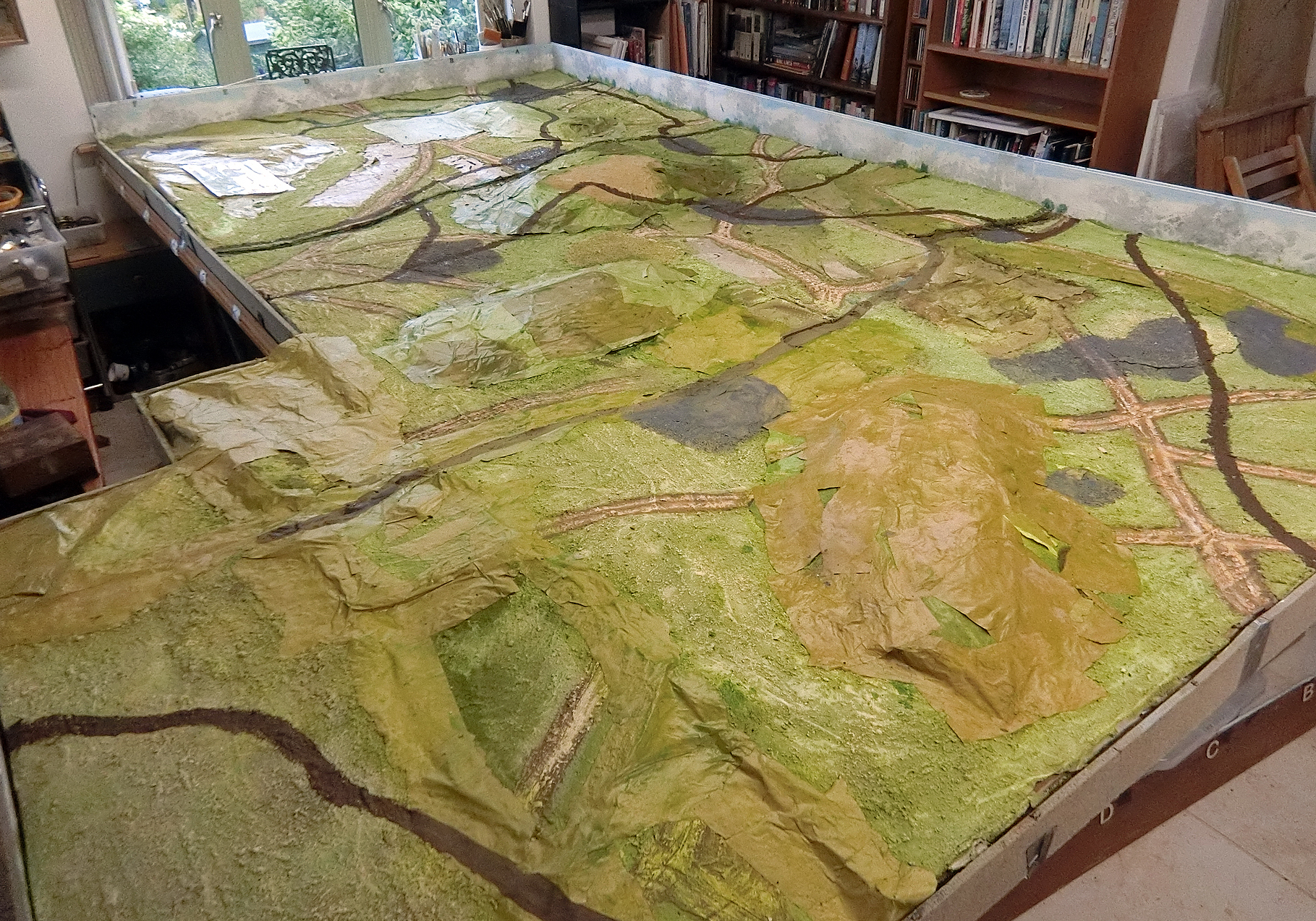
I started off by stripping off the extras like fields from the previous Lutzen terrain so they could be used again.  Buildings and woods obviously came off as they were "add-on" pieces anyway. Then I used loads of old pieces of past terrains  (polystyrene, cardboard and papier mache coatings) from the garage store to shape roughly the high ground for Abensberg. then I did my usual method of extensive papier mache work to blend them in. Thin green paint was roughed in to give me a feeling of unity of old and new.

  I'll let the following sequence of photos tell the story

Above and below: The old pieces combined with new contours produced an odd patchwork. This shows the  "extra bit" of 13 square feet of terrain used to extend the battlefield essentially to Bachl village.

To give me a sense of progress and scale I have marked the roads and rivers (thin dark lines) but thse are nowhere near their final look

I've painted the BUA footprints in grey at this early stage to help focus on map locations for all the features

It's still a mess but I know where I'm going.......!

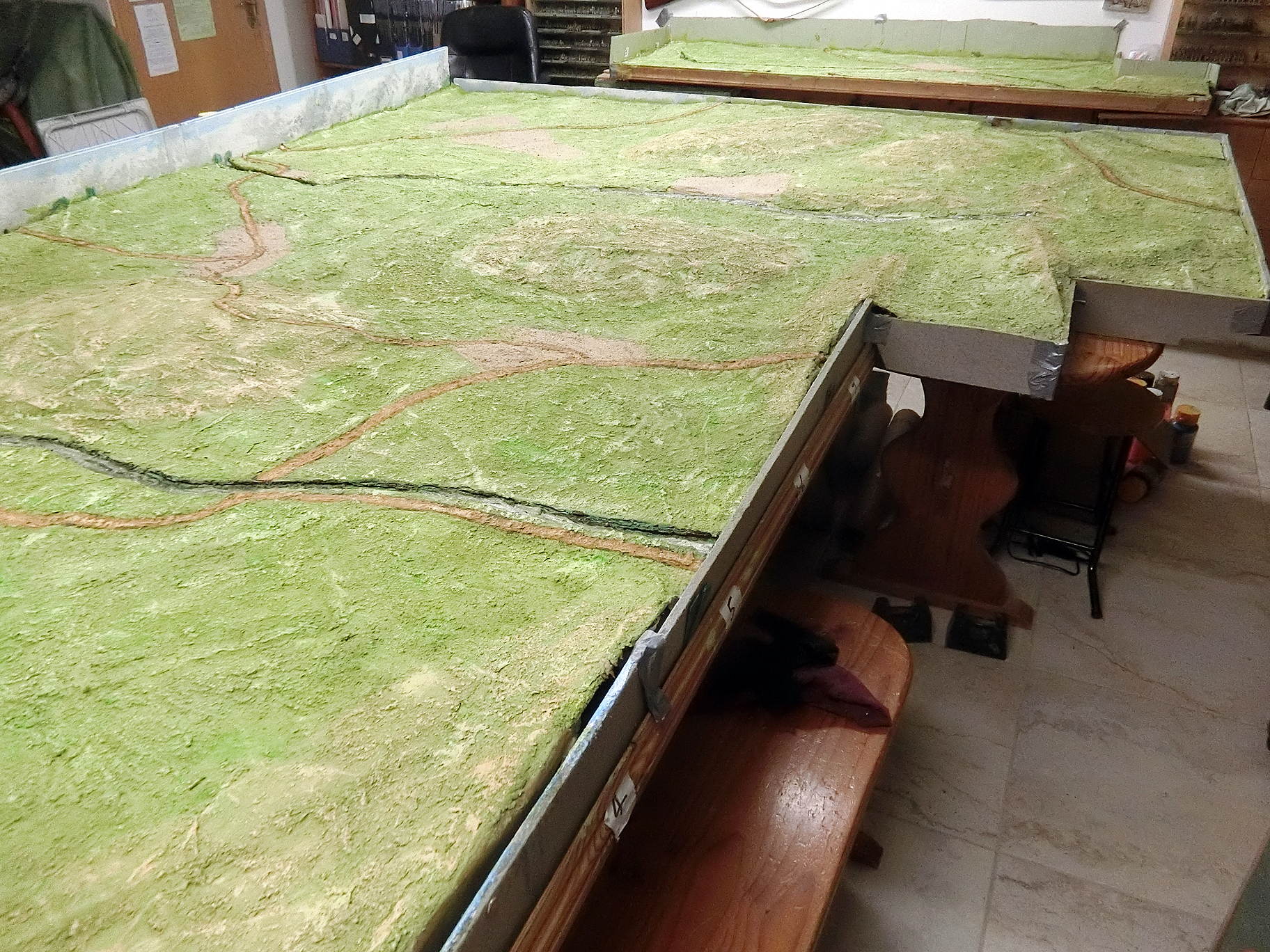
.......Here - a coherent look through a couple of days' work of mixing sawdust, sand, dry plaster, paint, PVA and water, and painting the whole thing

Close up of drying surface with unfinished road and river


This shows the extra bit which is designed to fit on my side chest of drawers exactly parallel to the equivalent squares on the main table. It would be fairly easy to transfer troops across during the game.

Mostly the rivers sat in a recessed channel in the cardboard surface. They needed many coats of paint/PVA mix to give a shiny, hard surface, and later several coats of acrylic gloss varnish

I used a Surform tool to chip off the nibs of sawdust when the surface was completely dry. That
helped a smoother effect (right for 15mm figures as opposed to 28mm) and also produced some nice "grass" scatter the same colour as the table.

A fun part for me was taking a variety of acrylic colours and applying in various shades by dry brushing to get a coherent look but with variety in it. I find it useful for players to see the higher ground dry-brushed lighter. (I try to use cheaper paints like school squeezy bottle pigments, but also use Rowney, and Winsor and Newton ones from my 2D art stocks).


This stage takes about a day to dry out during which time the
 colour generally lightens

By now I'd painted the rivers a blue-grey with considerable white tops  to
represent the light catching the flow of hillside water courses

Ready for the detail add-ons now.

The completed tabletop terrain
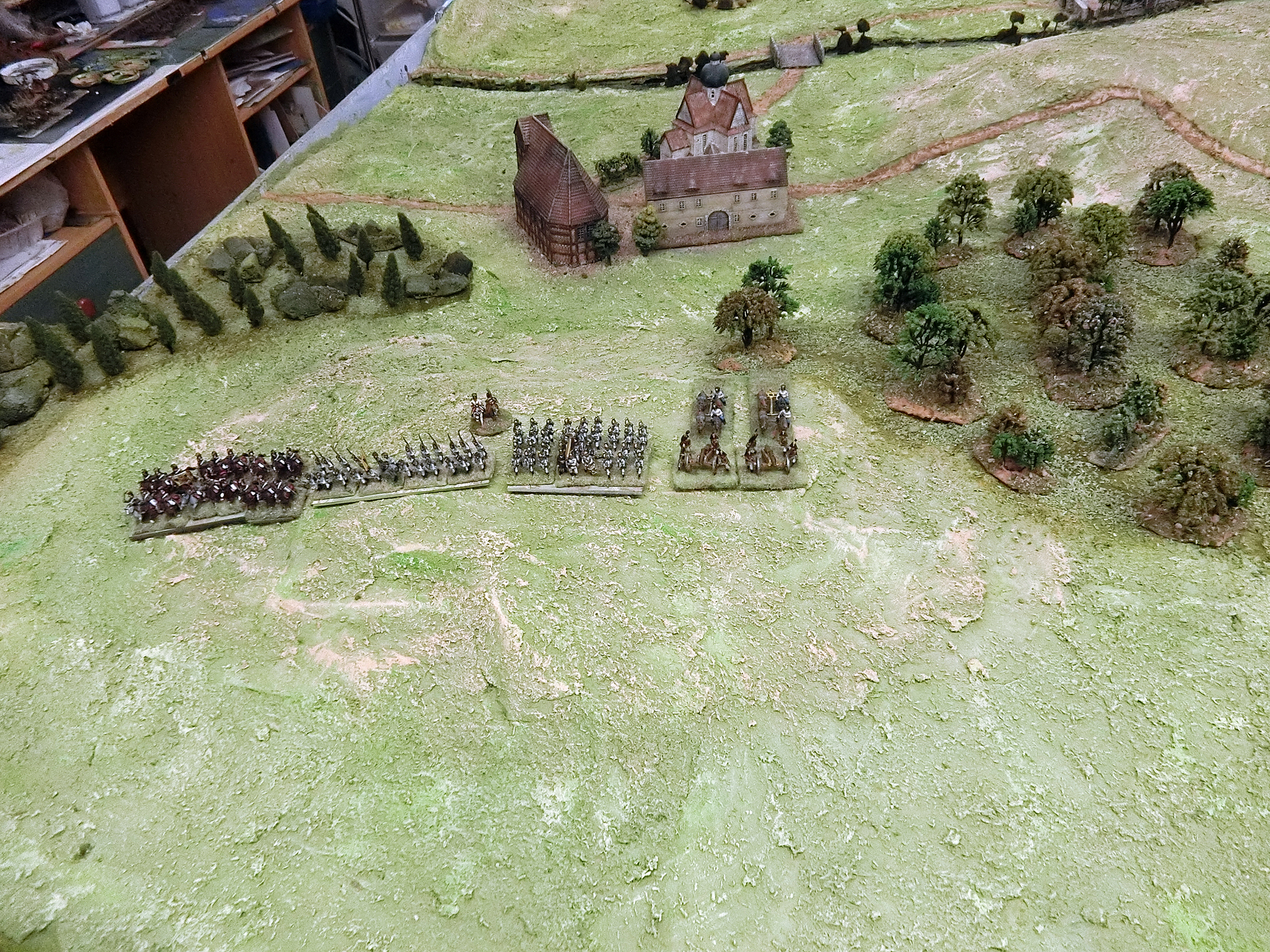
Once I'd worked out where the woods were to go I painted their footprints too. Then selected all the buildings and trees I needed from my store boxes, and assembled the whole thing to send the players their "walking the battlefield" photo tour.  I put some units of Austrians in to assist them marking their maps with correct unit sizes. There are rather a lot of pictures but they make a nice set and will give viewers a good sense of how the armies might manoeuvre through the light woods and open spaces.


To ease play I ensured most of the woods were designated as "open". However there were 4 smallish areas of dense wood, shown darker on the map, and here represented by larger, darker and more pointy fir trees.


This village was made of small (about 8mm) homecast plaster town houses, and 10mm 3D printed ones in the foreground


By the river crossing I have used some Peter Dennis downloadable buildings printed at a size suitable to fit in with the 12mm and 15mm 3D printed ones

Exceptionally, Keller was made from 6mm resin buildings and scratch-built walls arranged to take my 15mm figure bases. I wanted to give some sense of a fortified and defendable farmhouse - presumably from that name a wine-making or brewing enterprise?


Most of the villages were made up using Germanic 3D printed buildings  seen on this blog in previous games

Houses in The Horlbachs - Unter, Mittel and Ober shown as one BUA, are some of my home made card balsa wood and plaster thatched ones seen in the Lutzen game in April 


Just to finish off this part three more pictures taken by Glenn on Day Two.

Part Two - start of the game , will be about two weeks due to other commitments.