I was very fortunate to be invited by Keith Flint (of "Honours of War" fame) to the very first Cotswold Wargaming Day held on 2 September 2018 in the small town of Northleach off the A40 in the mid-central Cotswold Hills in Gloucestershire.
Keith had organised this and had invited various wargamers he knows in the general Gloucestershire/ West Country area. I live only about 20 miles away from the venue but I met wargamers from a distance - at least Plymouth and Aldershot, and not so far away at Cirencester. Keith had the backing of veteran wargaming legend Stuart Asquith who proudly said he lives near enough to "walk home to lunch and back again". Stuart and Keith had put up prizes, and also with the sponsorship of Osprey Publishing to reward the game organisers for their efforts. 18 attended in various capacities and took part in five games, some ran twice during the day. A small £5 donation each covered hire of the spacious hall and included self service tea, coffee and biscuits all day! Keith allowed me a nice amount of space for my display of military paintings, which I hope was of general interest, and I made at least one new acquaintance and client out of it as well as discussing a new commission in detail with another.
First a general look round and then a bit more detail of what interested me most.
 |
| Willz Harley's classic Spencer Smiths in an SYW Imagi-Nations game |
 |
| WW2 in Normandy by Jon in 15mm using Battlegroup Panzer Grenadier rules |
 |
| In the words of Bruce McCallum: "my own easy flight/squadron level air rules. Operation Cinzano, Italian biplanes v Hurricanes over Suffolk in November 1940, when you thought the Battle of Britain was over. (Spitfires & Me 109s in there too!)." Sorry I don't know any more about this apart from that Bruce was treating participants to caviar to snack on!!!!. |
 |
| Display of original paintings by yours truly |
 |
| Battle of Talavera 1809 using classic 1:76 scale Hinton Hunt figures, by Roy Boss, Mark Barnett and Stuart |
 |
| Seven Years War using "Honours of War" rules in 28mm by Steve and Paul |
Talavera in "20mm"
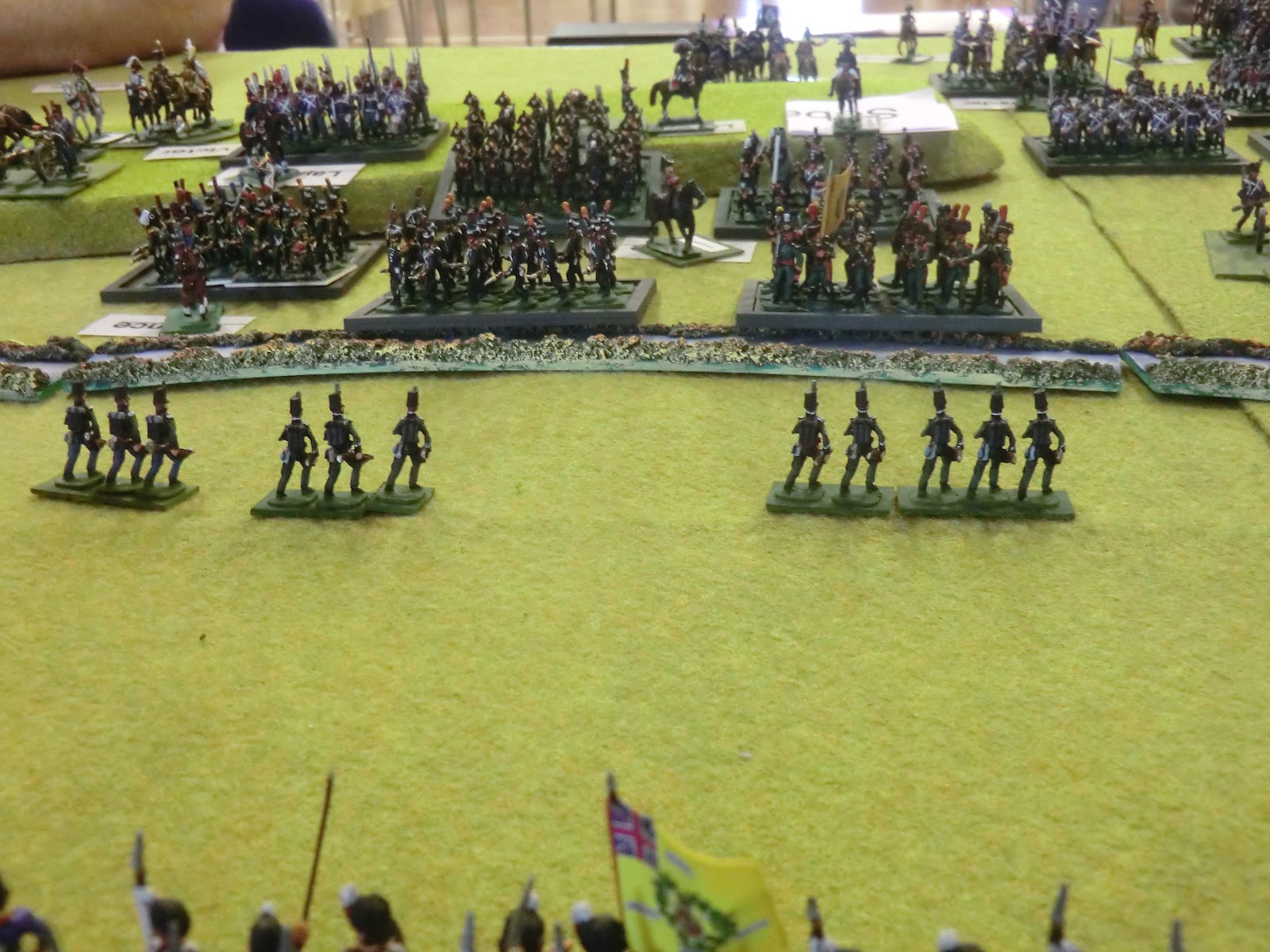
When the Cotswold Wargaming Day had originally been planned for March this year and had to be cancelled due to snow I had signed up for Roy and Stuart's classic "20mm" Napoleonic game for purely nostalgic reasons. As a lad when I first started Napoleonics Hinton Hunt figures were a market leader but a bit pricey for me and most of my metal collection was the cheaper and more bland Miniature Figures. So the idea of playing a full blown battle with just part of Roy's classic Hinton Hunt collection was too much to resist. (Apologies for the poor picture quality - the light in that part of the hall just did not like my camera.)
A bonus was that we were to use a 1970s style set of rules called "Muskets and Marshals" by Ian Spencer. Fistfuls of dice, saving throws, casualties in figures not points, simultaneous movement, non-scaled-but-fun weapons ranges - you get the idea.....So this was Talavera 70s style. That meant using historic orders of battle with each battalion at 24 figures and cavalry regiments of 12, lots of guns and the whole battlefield represented on a 10 x 6 table.
An 8 inch musket range maximum compared to 36 inch artillery range seemed a bit disproportionate but I was here for nostalgic wargaming not a simulation, and it all worked pretty well. So, willing suspension of disbelief and get stuck into those 12 dice per infantry volley and enjoy the mayhem! (Hey, I love saving throws anyway!)
 |
| Stuart Asquith casts a practiced eye over the proceedings. See my open left flank in the foreground |

I innocently asked if I could go British, and that was before I knew it was Talavera. Matt was busily putting out the French and the Allies had been placed along the ridges, redoubt and city as if deployed. Although they were all in exposed column blocks on super custom made trays I did not query it - mine not to reason why when playing a new set of rules in someone else's game. And then almost by accident I had been nominated as Sir Arthur Wellesley and was having the orbat briefed verbally, loosely given a historic map as a guide, and a formal historical order of battle in a book in Spanish! To my (pleasant) surprise I was told the "deployment" was only approximate and I was to redeploy how I thought fit within the general historic areas. So, getting my head round the battalions, brigades and divisions at no notice proved a bit more of a challenge than the "old school" muck around that I had expected! Who says wargaming does not keep your brain nimble? Anyway I got there in the end and was quite pleased with my lines and use of reverse slope, except for the exposed left flank which Roy assured me would be secured later.
I won't be giving a blow by blow account but just enjoy the pics of the classic troops with some annotations.
 |
| Spanish hold the area of the redoubt |
 |
| View along the French main line |
 |
Some game balance was given by the French dominance in artillery but the British
had quite a lot of nifty rifle-armed skirmishers |
Although I got the troops deployed Stuart turned up just in time to command the British troops on the big left flank hill. Player-umpire Roy had the Spanish, and kept most of the Allied cavalry in a central reserve position. Matt and Tim commanded the French.
 |
Guards Brigade and other British take cover on the reverse slope but my guns
were horribly exposed to the big French battery |
 |
| Even though fairly well back my central infantry were to suffer from those guns throughout |
 |
| Tim launched a single regiment of Polish lancers to push back my riflemen... |
 |
.....which they did but fell foul of rifle fire and musketry from squares and
fell back sorely depleted |
 |
Matt's columns' suffered from Stuart's guns so the French attack voluntarily
halted along the stream valley so his own guns could fire over them |
 |
| My lines held firm in the centre |
 |
| Spanish gun crews in the redoubt got diminished by counter battery fire |
 |
| Roy brought some of our cavalry reserve on the left flank (as he had promised) for Stuart to counter attack. At left a French column charged one of our battalions while it was in square and pushed it back in disorder....but that left the French vulnerable to counter attack which sent them packing. British guns were being smashed by the grand battery. |
 |
| In the centre the attacking columns formed lines and began to blow my riflemen away by musket volleys |
 |
Stuart departed at lunchtime and left me to revive the left flank. Nice score by my Spanish
light horse saw off the French Dragoons and this began a significant start to an
Allied outflanking of the French right |
 |
| French columns move forward again now the British guns have gone |
 |
| And the grand battery starts to batter whatever infantry are exposed on the crest |
 |
Spanish troops continue to relax in Talavera so Roy can concentrate on contesting
the redoubt |
 |
Tim chose to attack across the river with cavalry.
I succeeded in forming an emergency square,,,,
.......and these were his melee dice scores!
Depleted cavalry regiment shown below |
 |
| To give us more manoeuvring space and bring up reserves I advanced in the centre. Although the British infantry suffered they were making space for that cavalry regiment of Roy's at centre left of the picture. |
 |
| Sadly Roy's Spanish flee from the redoubt against good French troops (and below). |
 |
In the final act of the game Matt attacked all along the ridge and received only average
casualties from my British lines. A couple of his battalions charged home and both won their melees
which posed difficult issues for a successful British outcome to the battle. |
We had played from about 1030 to 1620 with a break for lunch and had to stop with the game hanging in the balance. There had been a lot more incidents than this space allows me to describe but essentially the battlefield ended up as four different zones:
- Allied left: Significant Allied cavalry strength meant a severe threat to the French flank and would inhibit further progress of the French attack.
- Allied centre left: French dominance of the big hill but Matt's lead battalions were now weak and there were still some British reserve battalions
- Centre: Roy's cavalry had broken a leading French battalion at the stream so I was fairly confident that my strong reserves could repel any further French attempt in this area
- Allied centre right: The redoubt was lost and the French were storming through towards Talavera and still had uncommitted battalions.
I couldn't stay to hear Roy's pronouncement on a result but I think it would be something along the historical lines - French marginally beaten tactically and with significant losses, but Wellesley would deem that with most of his artillery and light troops shattered he would use his superior cavalry position to cover a strategic withdrawal and leave the Spanish to it!
(Care to comment Roy?)
Great fun and a very relaxed atmosphere. Matt and I were almost trying to outdo each other in gentlemanly play! At one point we couldn't decide so just diced for it. Pragmatic Roy came up and realised the rules did cover the situation but said "Why interfere when both players are happy with a dice decider!" Regular readers know I like a "serious" historical wargame in my own space but when I'm away from home it's OK to play just for fun isn't it? This game fitted the bill perfectly - history, nostalgic figures and rules and good company. Thanks to Roy, Matt, Tim and Stuart for making it possible. Also it confirmed my view that 1:76 (22mm) is an ideal size to refight a historic battle and I will be planning to redo my SYW armies accordingly sometime in the future.
Seven Year's War - Imagi-Nation game
I reported on Will Harley's successful gaming with his classic armies at the Kenilworth Wild Geese gathering in June and he felt able to travel North again for our benefit in Gloucestershire.
Will told me he fell into collecting Spencer Smith figures more or less by accident a few yeras ago and ended up buying many hundreds, and creating two Imagi-Nation armies. For those not familiar with SS they started life in the 1960s as bags of about 50 x "30mm" polythene figures all in the same marching position - grenadier and musketeer, with a few random officers and drummers. There were three or four mounted poses and a few gunners and that was it. The figures lacked detail so could be painted pretty much as any 18th century types you wanted. Willz has recreated the ingenuity of those early years but applied a more sophisticated painting style and matt finish which gives the armies an appearance of elegance and polish comparable with any modern 28mm range. He justly got public praise for this from Stuart Asquith who awarded Willz the prize for "Best Painted Armies".
Enjoy:
 |
| Classic-style big battalions |
 |
| Above pictures during the first game of the day |
 |
| Keith took part in the second game - both games used Jim Purky's rules (of Fife and Drum Miniatures) |
 |
| The versatile dragoon figure - a particular favourite of Willz' |

 |
Keith Flint - without whom we would have neither the Cotswold Wargaming Day
nor the brilliant "Honours of War" rule book |

 |
| Willz explains a point to Keith........ |
 |
| ......and then spots the camera and you can't keep a straight face long next to Willz! |
The day also included a speech and prize giving by Stuart Asquith. There was a prize for "Most Gentlemanly Gamer" and who could argue against Bruce winning that - serving caviar with his game! Each of the games got a prize for some aspect of our hobby at which it excelled but Best Overall Game went to - Talavera, in which I was privileged to play Wellington, so I could not disagree it was a great choice.
 |
| Roy and Matt receive their prizes from Stuart |
 |
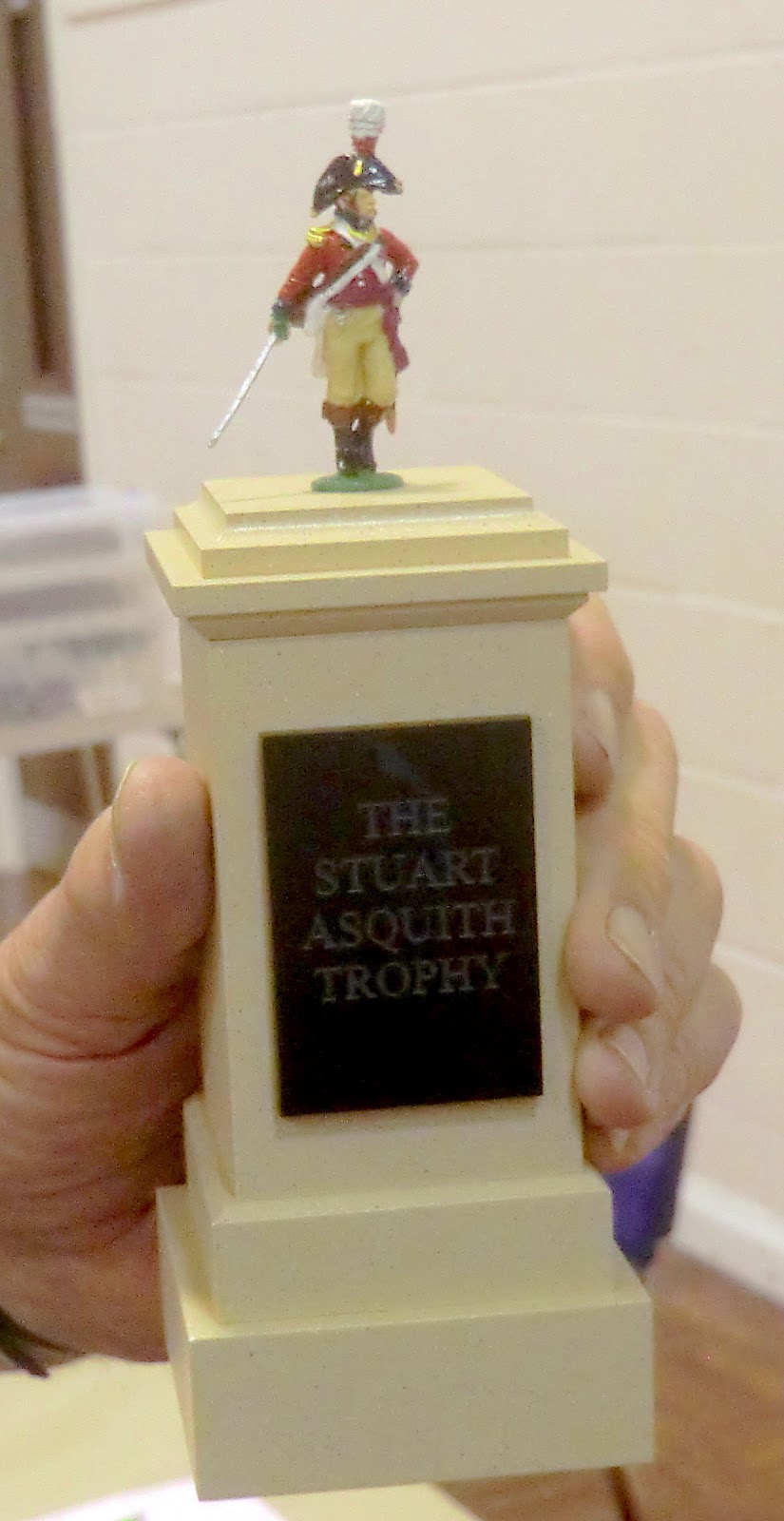
| The magnificent Stuart Asquith Trophy which will be competed for next year |
Many thanks from me to Keith and Stuart for organising such an enjoyable day not very far from home, and to Roy and Matt for putting up with me at Talavera.
Feedback has encouraged Keith to agree to organise CWD2 on 1st September 2019 at the same venue and he hopes to encourage more game organisers and players than for this inaugural venture. So if you live in the general Central/South -West of the UK and fancy organising something you can either get in touch with Keith directly or email me and I will pass it on.